

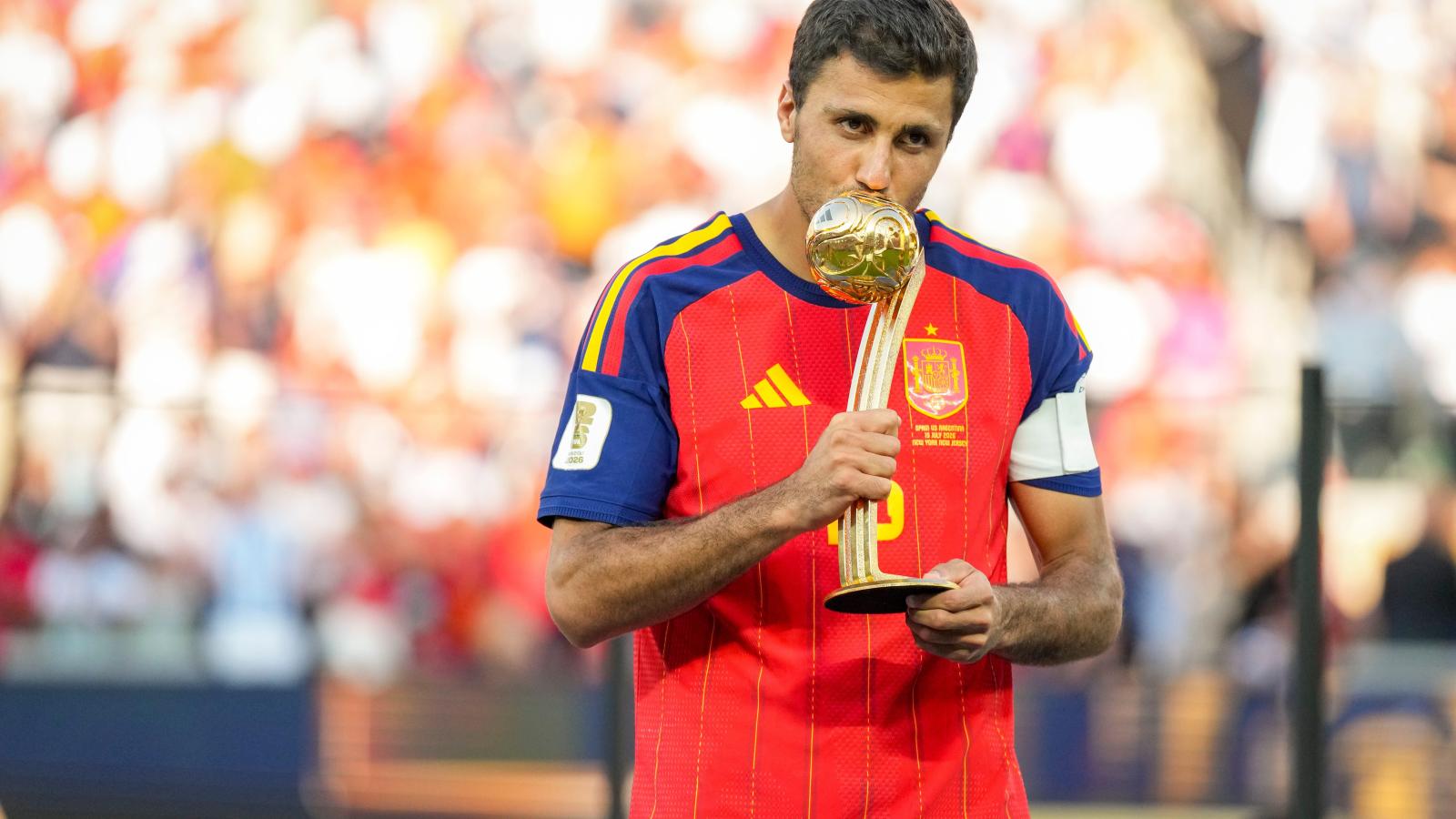
Real Madrid are working on a move to sign Rodri from Manchester City this summer, with the midfielder’s performances at this summer’s World Cup helping to intensify interest in one of the game’s most influential holding players. The situation carries weight because Rodri is far more than another experienced midfield option; he is a specialist in control, positioning and rhythm, the type of player who can reshape how an elite side manages matches at the highest level. At 30, he remains one of the defining reference points in his role, and his contract situation has added another layer of intrigue to the market. With Rodri entering the final year of his City contract and talks still ongoing over his future, this has become one of the summer’s most significant midfield stories.
- Real Madrid are working on a summer move to sign Rodri from Manchester City.
- Rodri is 30 and has entered the final year of his City contract.
- His current deal runs until 2027, with talks ongoing over his future.
- Rodri’s performances at this summer’s World Cup have increased Real Madrid’s interest.
- Manchester City are weighing the risk of losing a key midfielder whose positional sense and control would be difficult to replace quickly.
Why Madrid’s Interest Has Grown
Real Madrid’s interest makes immediate football sense because Rodri offers a profile that is both rare and highly transferable to the demands of knockout football and long league campaigns. His game is built less on spectacle than on authority: occupying the right spaces, protecting transitions, circulating possession cleanly and giving structure to the players around him. Those qualities often become even more visible on the World Cup stage, where tactical discipline and emotional control can separate contenders from the rest. In that context, Madrid’s admiration appears to have sharpened into active work on a potential deal.
The World Cup factor is especially important because tournament football places a premium on midfielders who can slow chaos and impose order. Rodri’s reputation has long been built on that ability, but strong displays in a summer tournament naturally renew attention from clubs seeking certainty in central areas. For Real Madrid, that means focusing on a player capable of anchoring possession while also helping a side survive difficult moments without losing its shape. It is one thing to dominate domestically through technical quality; it is another to control the biggest matches, and Rodri’s appeal lies in giving a team the platform to do exactly that.
There is also a broader strategic logic to the move. Elite teams are constantly trying to reduce volatility in the center of the pitch, because that is where matches are often won before the decisive actions arrive in either penalty area. A midfielder with Rodri’s positional sense can make defenders feel more secure, free more creative players to take risks higher up the field and help a side recover territorial control after spells of pressure. Real Madrid’s interest therefore reads as more than opportunism; it reflects a search for a player whose influence extends across every phase of the game.
What It Means for Manchester City
For Manchester City, the issue is not only whether another club wants Rodri, but how difficult his specific role would be to replace in a short time frame. The concern around losing him is rooted in his command of space and tempo, two qualities that are exceptionally hard to replicate through a simple like-for-like transfer. Many midfielders can pass well, many can defend aggressively and many can cover ground, but far fewer can stitch those responsibilities together with the calm and timing required at the top end of the sport. That is why City are weighing the risk so carefully: replacing a key midfielder is one challenge, replacing a system-defining one is another entirely.
His contract situation adds urgency to the equation. Rodri has entered the final year of his City contract, even with his deal described as running until 2027 and talks still ongoing over his future, which leaves this summer as a critical decision point. If negotiations do not produce clarity, the balance between sporting need and contract management becomes much harder to maintain. Clubs at this level always have to consider not only the immediate season ahead, but also the long-term value of their most important assets, and uncertainty around a player of Rodri’s stature inevitably sharpens that calculation.
From City’s perspective, the challenge is magnified by the speed with which elite midfields are assembled and disrupted. A side can spend years building automatisms around one holding player’s reading of danger, passing angles and movement between the lines, only to discover that those details are not easily reproduced by a newcomer. Rodri’s control is not merely technical; it is relational, affecting how full-backs advance, how central defenders split in possession and how attacking players position themselves to receive the ball. That interdependence explains why the prospect of losing him would carry consequences beyond a single position on the teamsheet.
For Real Madrid, meanwhile, the attraction is obvious precisely because of those same qualities. A player who can dictate spacing and provide calm under pressure tends to raise the collective level of everyone around him. He can make a team more secure without making it more cautious, and more patient without making it passive. In that sense, Madrid’s move is understandable as a pursuit of competitive control: the kind of signing designed not just to add depth, but to alter the balance of major matches in their favor over the course of a season and in the decisive rounds of the World Cup cycle.
The road ahead now depends on whether City can resolve Rodri’s future through ongoing talks or whether Madrid’s interest develops into a more forceful test of their resolve. What is already clear is that Rodri’s World Cup performances have raised the temperature around his situation and turned a contract discussion into one of the summer’s defining midfield storylines. Real Madrid are working on the move, City are assessing the risk of losing a player whose control would be difficult to replace quickly, and the next phase will be shaped by whether negotiation or ambition proves stronger. As the summer unfolds, this is a situation with the potential to influence not only two elite clubs, but also the wider market for top-level midfielders.



Leave a Reply