
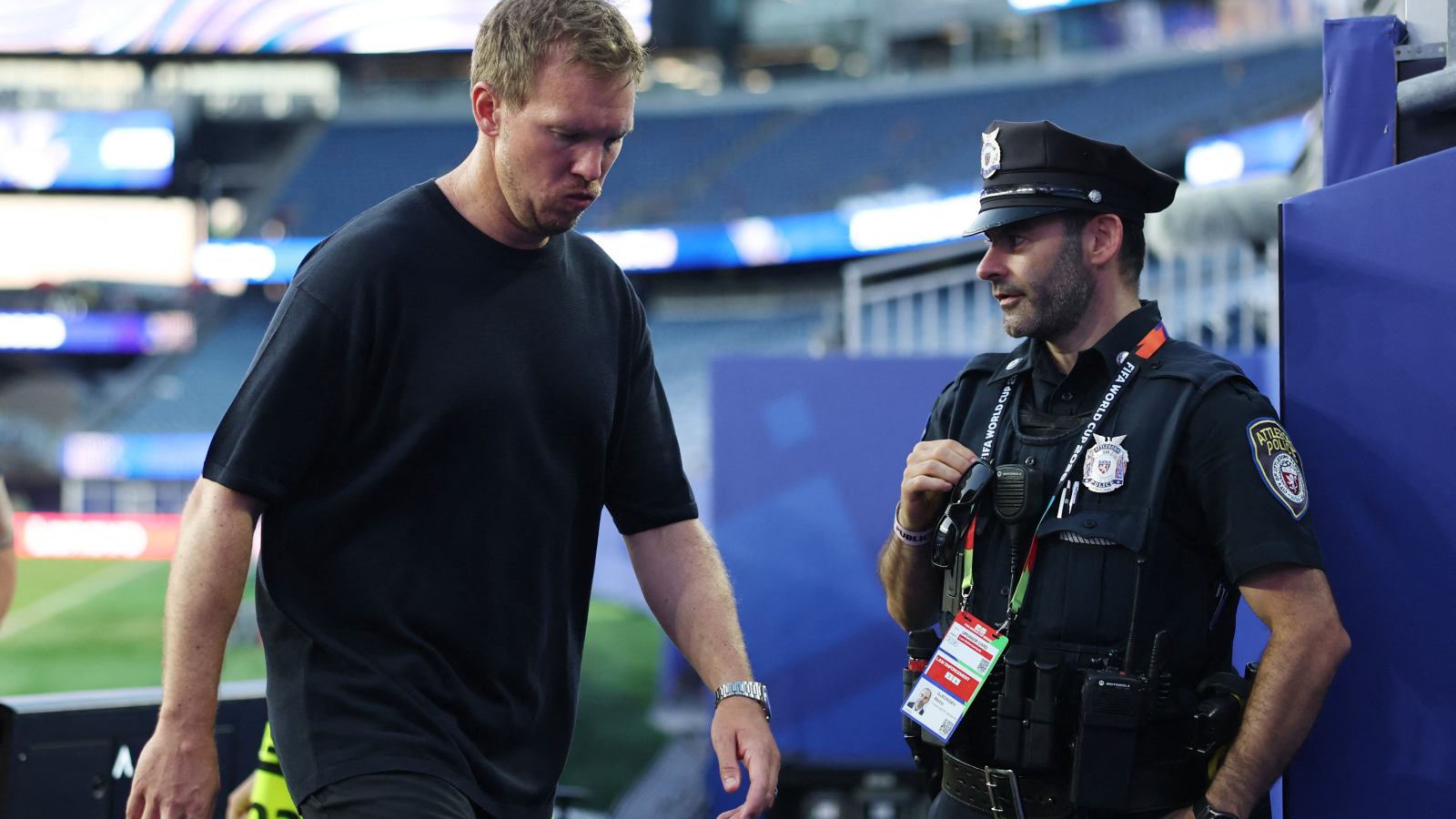
Germany are expected to decide Julian Nagelsmann’s future within days of their World Cup exit, a development that has left one of football’s biggest powers at a crossroads. Nagelsmann’s position is under serious doubt after a disappointing campaign, and the uncertainty has quickly shifted attention to what comes next for the national team. Jürgen Klopp has emerged as the standout name in the immediate aftermath, with growing discussion around him as Germany’s leading target if a change is made. Yet the situation remains unresolved, with no final decision confirmed and voices within the camp still backing Nagelsmann to stay.
- Germany are expected to make a decision on Julian Nagelsmann’s future within days after their World Cup exit.
- Nagelsmann’s position is under serious doubt following a disappointing tournament campaign.
- Jürgen Klopp is being discussed as Germany’s top target if Nagelsmann leaves.
- Nagelsmann has said Klopp has not considered the job and is focused on his current role.
- Germany captain Joshua Kimmich hopes Nagelsmann stays and says the players bear responsibility for the exit.
Nagelsmann’s position under intense scrutiny
The speed with which Germany are expected to reach a decision underlines the scale of the disappointment surrounding their World Cup exit. For a nation with Germany’s standards, an early departure is never treated as a routine setback, and that reality has placed Nagelsmann under intense scrutiny. The issue now is not only the result itself, but whether the federation still believes he is the right figure to lead the response. When a coach’s future is described as being under serious doubt, it points to a wider debate about direction, authority and whether the current project still carries full confidence.
That uncertainty is sharpened by the timing. World Cup exits tend to compress decision-making because the next cycle begins almost immediately, and Germany cannot afford an extended period of drift. If the leadership believes a change is required, acting quickly would give a successor time to establish control and shape the next phase. If the decision is to keep Nagelsmann, that verdict would also need to be delivered clearly, because anything less would leave him operating under a cloud. In either case, the coming days appear decisive for both the coach and the wider mood around the national team.
There is, however, an important distinction between pressure and conclusion. The facts available point clearly to a coach under genuine threat, but they do not show that his departure is inevitable. That matters because post-tournament reactions are often driven as much by emotion as by long-term planning, particularly when expectations have not been met. Germany’s challenge is to separate the understandable frustration of elimination from the broader judgment of whether Nagelsmann can still deliver progress. For now, the only certainty is that his future remains uncertain.
Klopp’s name changes the conversation
Klopp’s emergence in the discussion has inevitably shifted the debate from one centred on disappointment to one shaped by possibility. He is being talked about as Germany’s top target if Nagelsmann leaves, and that alone raises the stakes around the decision. A candidate of that stature changes the tone because the conversation is no longer only about whether Germany should act, but whether this is a rare chance to pursue a manager of enormous standing. Even without any formal move being confirmed, Klopp’s presence in the background gives the situation a different weight.
At the same time, Nagelsmann has pushed back on the idea that Klopp is actively in line for the role, saying Klopp has not considered the job and remains focused on his current position. That response is significant because it adds caution to a narrative that could otherwise move too far ahead of the facts. Germany may admire Klopp and may view him as a leading option, but admiration is not the same as availability. In practical terms, that means any decision on Nagelsmann cannot simply be framed as a straightforward swap. If Germany do move on from their current coach, they would still need to determine whether their preferred target is genuinely attainable.
This is where the story becomes as much about strategy as personnel. Pursuing a top target can be appealing, but it also carries risk if that target is neither ready nor willing to take the job. Germany therefore have to consider not only Klopp’s appeal, but also the consequences of making a change without complete certainty over the next appointment. That calculation could strengthen the case for continuity, especially if decision-makers believe the squad’s underperformance cannot be placed solely at the coach’s door. The more complicated the succession picture becomes, the stronger the argument for a measured decision rather than a reactive one.
Kimmich’s support for Nagelsmann adds another important layer, suggesting the dressing room is not united behind the idea of a managerial reset. As captain, his view carries obvious significance, and his insistence that the players bear responsibility for the disappointing campaign shifts part of the focus away from the bench and onto the squad itself. That does not remove the pressure on Nagelsmann, but it does challenge any simplistic reading of the exit as a coaching failure alone. In elite international football, results are shaped as much by execution as by planning, and Kimmich’s stance points to a collective shortfall rather than a single cause.
That backing could matter in the final deliberations because federations often weigh not only results, but also whether a coach retains credibility with senior players. If key figures still believe in Nagelsmann, the argument for keeping him becomes easier to make. Continuity can carry real value after a poor tournament if the belief remains that the underlying ideas are sound and that the players themselves must deliver more. On the other hand, Germany’s hierarchy may conclude that public support from the captain is not enough to outweigh the disappointment of the campaign. That tension between accountability and continuity sits at the heart of the decision now facing them.
What happens next is likely to shape Germany’s immediate future more than the exit itself. A decision to keep Nagelsmann would amount to a statement that the response should be correction rather than overhaul, with the focus on player responsibility and improved execution. A decision to part ways would signal that the tournament exposed deeper issues requiring a new voice and a fresh start, with Klopp certain to remain central to the discussion if that route is taken. Either way, Germany need clarity quickly. Their World Cup is over, but the consequences of it are only beginning.


Leave a Reply