

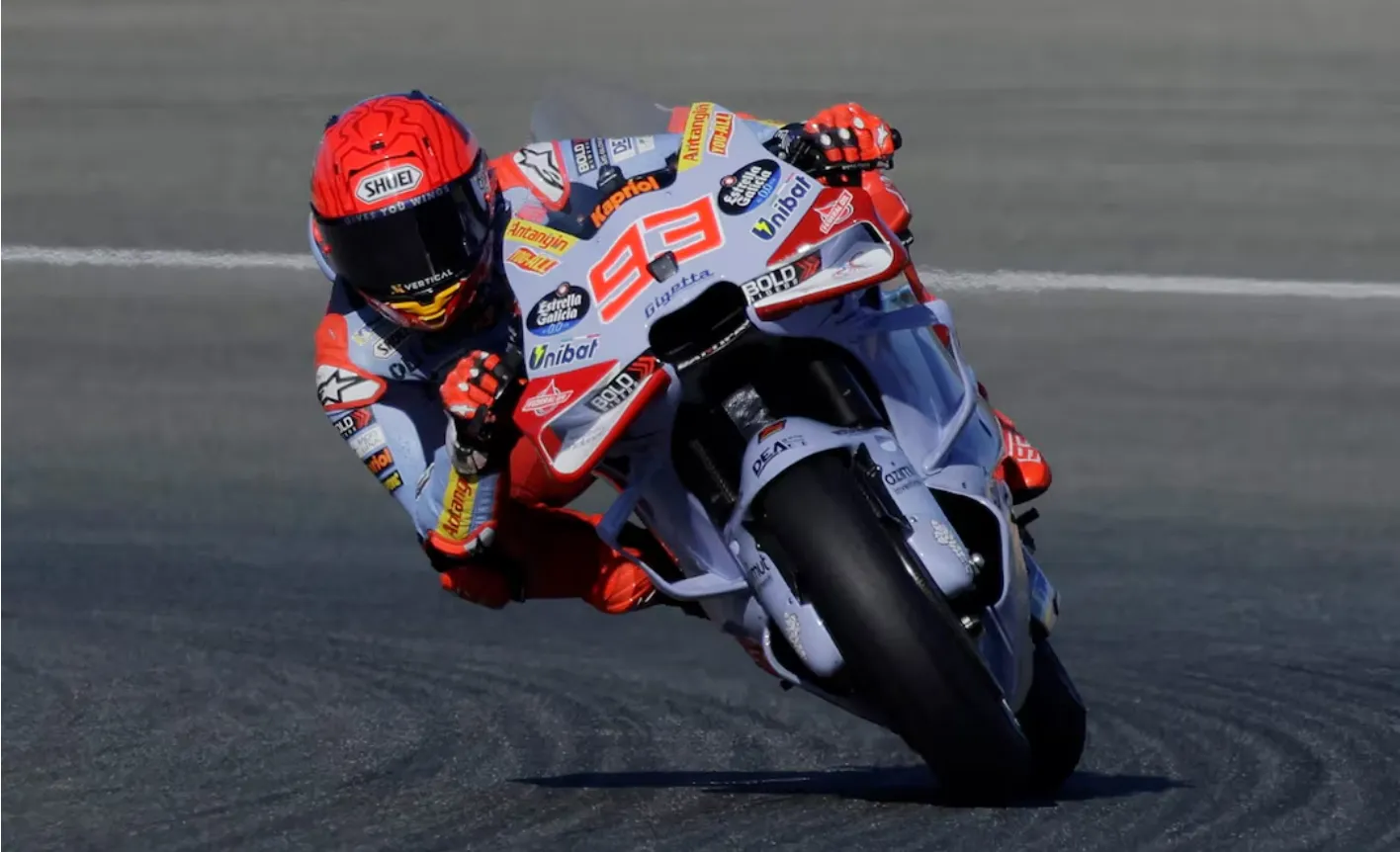
MotoGP race director Mike Webb has issued a detailed explanation regarding the controversy surrounding Marc Marquez’s pole lap cancellation during qualifying at the Japanese Grand Prix.
The incident occurred during Q2 on Saturday when Marquez, riding for Gresini Ducati, set a lap time of 1m42.868s, which provisionally placed him on pole position. However, Marquez exceeded track limits, which led to the cancellation of the lap. The delay in notifying Marquez about the cancellation left him with no time to attempt another legal lap, ultimately relegating him to ninth on the grid.
The controversy sparked anger from the Gresini team because officials did not immediately communicate the lap deletion. Webb clarified that the delay was due to a software glitch in the system responsible for detecting track limits violations, which prevented the automatic cancellation of Marquez’s lap.
MotoGP officials monitor track limits using sensors placed along the green-painted run-off areas, as exceeding the limits provides an unfair advantage. Typically, when these sensors trigger, they automatically invalidate lap times, and the cancellation quickly communicates to the rider. However, in this instance, the glitch forced the FIM MotoGP Stewards to manually cancel Marquez’s lap, resulting in a delay.
In a statement requested, Webb explained:

“The track limits sensor triggered immediately, which led to the automatic cancellation of any lap. The FIM MotoGP Stewards entered it into the system right away, but unfortunately, a software glitch interrupted this process and meant the lap then needed to be cancelled manually, causing a delay to the notification.”
Webb emphasized that this was the first occurrence of such an issue, despite officials processing thousands of track limits infringements each season. He also reassured that they had identified and rectified the cause of the glitch to prevent future incidents.
Due to the brief rain shower in the closing stages of Q2, Marquez opted not to push for another lap after his initial 1m42.868s, believing the lap time to be valid at the time. Despite his lowly grid position, Marquez put in a strong performance in the sprint race later that afternoon, securing third place.
While Marquez’s team voiced their frustration over the delay, the situation highlights the importance of ensuring the integrity of track limit policing in MotoGP. With the glitch now addressed, the sport aims to avoid similar disruptions in the future.


Leave a Reply