

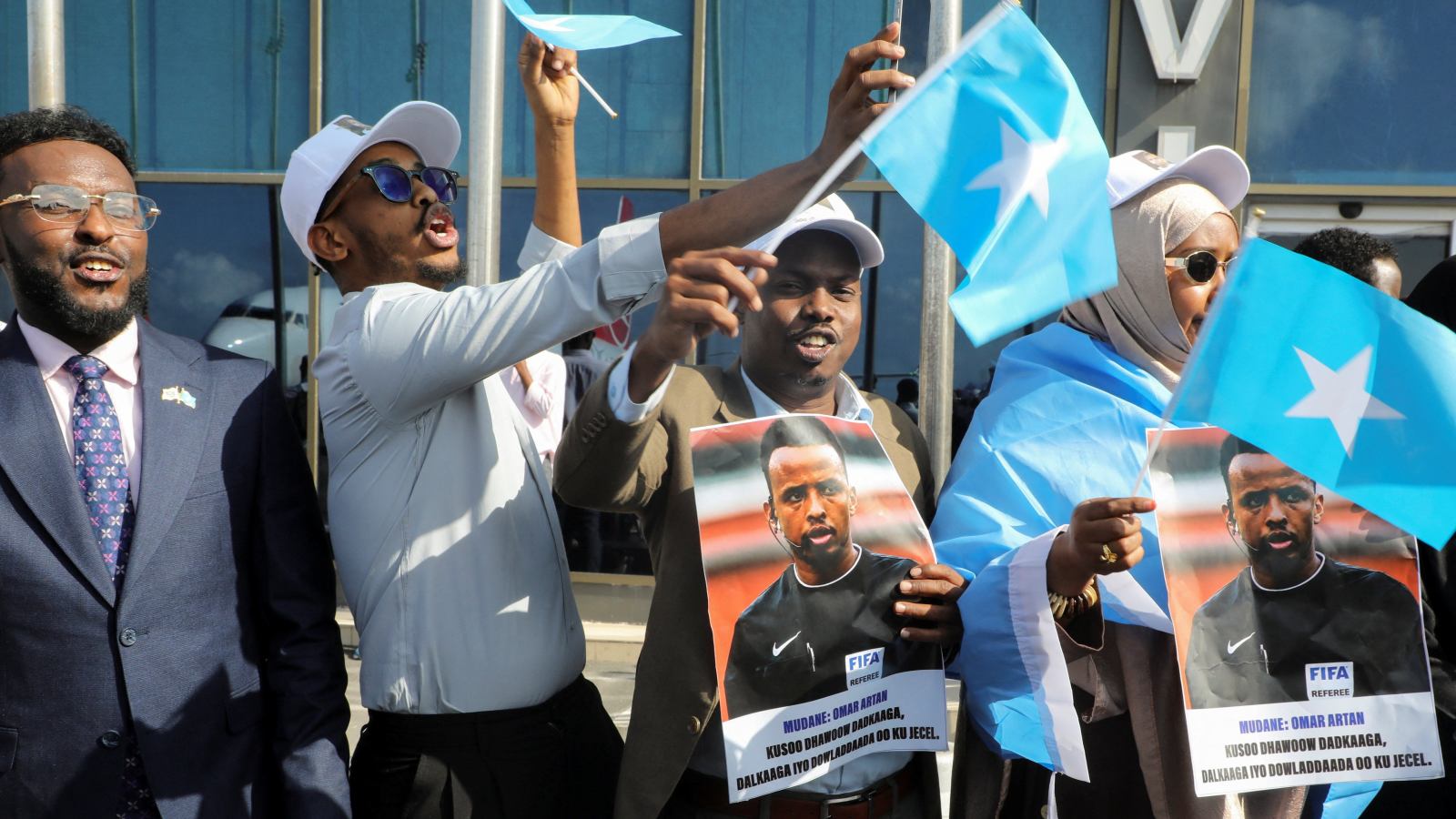
Omar Artan’s chance to officiate at the 2026 World Cup was ended by a visa issue that prevented the Somali referee from entering the United States, ruling him out of the tournament despite his selection. The setback carried obvious weight, as a World Cup appointment stands among the highest achievements in any referee’s career, particularly for an official from a nation with limited representation on football’s biggest stages. Yet the story did not end with that disappointment. Within days, Artan received another elite assignment when UEFA selected him to referee the Super Cup, turning a painful World Cup absence into a swift return to the top level of the international game.
- Somali referee Omar Artan was selected to officiate at the 2026 World Cup.
- Artan was denied entry to the United States because of visa issues, preventing him from taking part in the tournament.
- Reports of the visa problem emerged on June 9, 2026.
- UEFA appointed Artan to referee the UEFA Super Cup on June 11, 2026.
- The sequence marks a swift shift from missing the World Cup in the United States to receiving a major European final assignment.
A World Cup chance lost
The central fact of this story is stark: Artan had been chosen for the 2026 World Cup, only to be blocked from participating because he could not enter the United States. In a tournament spread across host nations, any administrative obstacle can carry outsized consequences, and in this case it ended the referee’s involvement before it could begin. That matters not only on a personal level for Artan, but also in the broader context of officiating pathways in global football. Selection for a World Cup is both recognition of sustained excellence and an opportunity to perform under the sport’s brightest spotlight, which makes missing out in this way especially significant.
For referees, major tournaments are often the clearest measure of professional standing. Players and coaches are judged publicly every week, but officials tend to build their reputations through appointments that signal trust from governing bodies. A World Cup selection is therefore more than a line on a résumé; it is confirmation that an official has reached the highest tier in the game. Artan’s inability to take part because of visa issues underlines how careers at the top level can still be shaped by factors beyond performance on the pitch. The disappointment is easy to understand because the opportunity to work at a World Cup is rare, and there is no guarantee it will come again.
The circumstances also highlight a tension that exists in modern international football. The sport presents itself as global and interconnected, yet access to its biggest events can still be affected by travel documentation and border controls. For a referee who had already earned selection on merit, the barrier was not technical ability, experience or form, but the inability to secure entry into one of the host countries. That distinction matters. It reinforces the idea that even at the highest level, careers can be redirected by administrative realities that sit entirely outside the competitive arena.
That is why the missed World Cup carries significance beyond a single appointment. For an official from Somalia, representation on a stage of that size carries added symbolic value as well as professional prestige. It reflects progress not only for the individual referee, but also for the visibility of officials from countries that are less frequently present in football’s most prominent moments. Missing the tournament does not erase the achievement of being selected, but it does alter how that achievement will be remembered. Instead of a World Cup campaign on the field, Artan’s 2026 story initially became one about exclusion before a ball was kicked.
Why the UEFA response matters
The speed of Artan’s next appointment gives the story its second, and equally important, dimension. On June 11, 2026, just two days after reports on June 9 said he had been denied entry to the United States, UEFA appointed him to referee the Super Cup. The timing matters because it shows Artan remained firmly in contention for major matches despite the World Cup setback. Rather than slipping from the elite conversation after missing the tournament, he was almost immediately placed in charge of one of European football’s most prominent one-off fixtures.
The UEFA Super Cup differs in scale and format from a World Cup, but it remains a high-profile final that demands authority, composure and complete trust from the appointing body. Handing Artan that match so soon after his World Cup disappointment sends a clear footballing message about his standing as an official. It suggests that, whatever administrative barrier kept him out of the tournament in the United States, his professional reputation remained intact. In practical terms, the appointment restores some of the visibility and prestige lost when he was unable to appear on the World Cup stage. In symbolic terms, it provides immediate professional validation at the highest level available in club-related international competition.
There is also broader significance in the contrast between the two developments. One moment shows how global football can still be constrained by travel documentation and border access, even for individuals selected for its flagship event. The next shows how quickly the sport’s institutional structures can reaffirm confidence in an official’s quality. That does not erase the magnitude of missing a World Cup, and it should not be framed as a direct replacement for that experience. But it does mean Artan’s year is not defined solely by exclusion; it is also defined by a major appointment that keeps him among the game’s most visible referees.
It is also important to stay within what can be confirmed. The broad sequence is clear and supported: Artan missed the World Cup in the United States because of visa issues and then received the UEFA Super Cup assignment. However, there is no independent verification in the available research for the line, “This was my World Cup,” so that sentiment cannot responsibly be treated as part of the confirmed record. Even without it, the verified facts present a compelling narrative. It is a story of frustration, resilience and institutional recognition, compressed into the space of a few days.
Looking ahead, Artan’s Super Cup appointment gives him an immediate platform to reassert himself on a major stage after the World Cup disappointment. While the lost opportunity in the United States will remain a notable part of his 2026 story, the subsequent European final ensures the year also carries a strong note of recovery and esteem. For Artan, the road forward now centres on turning that trust into another composed performance in one of the sport’s showcase matches. Missing the World Cup was a significant blow, but the next chapter has already returned him to where elite referees aim to be: in charge of a major final.

Leave a Reply