

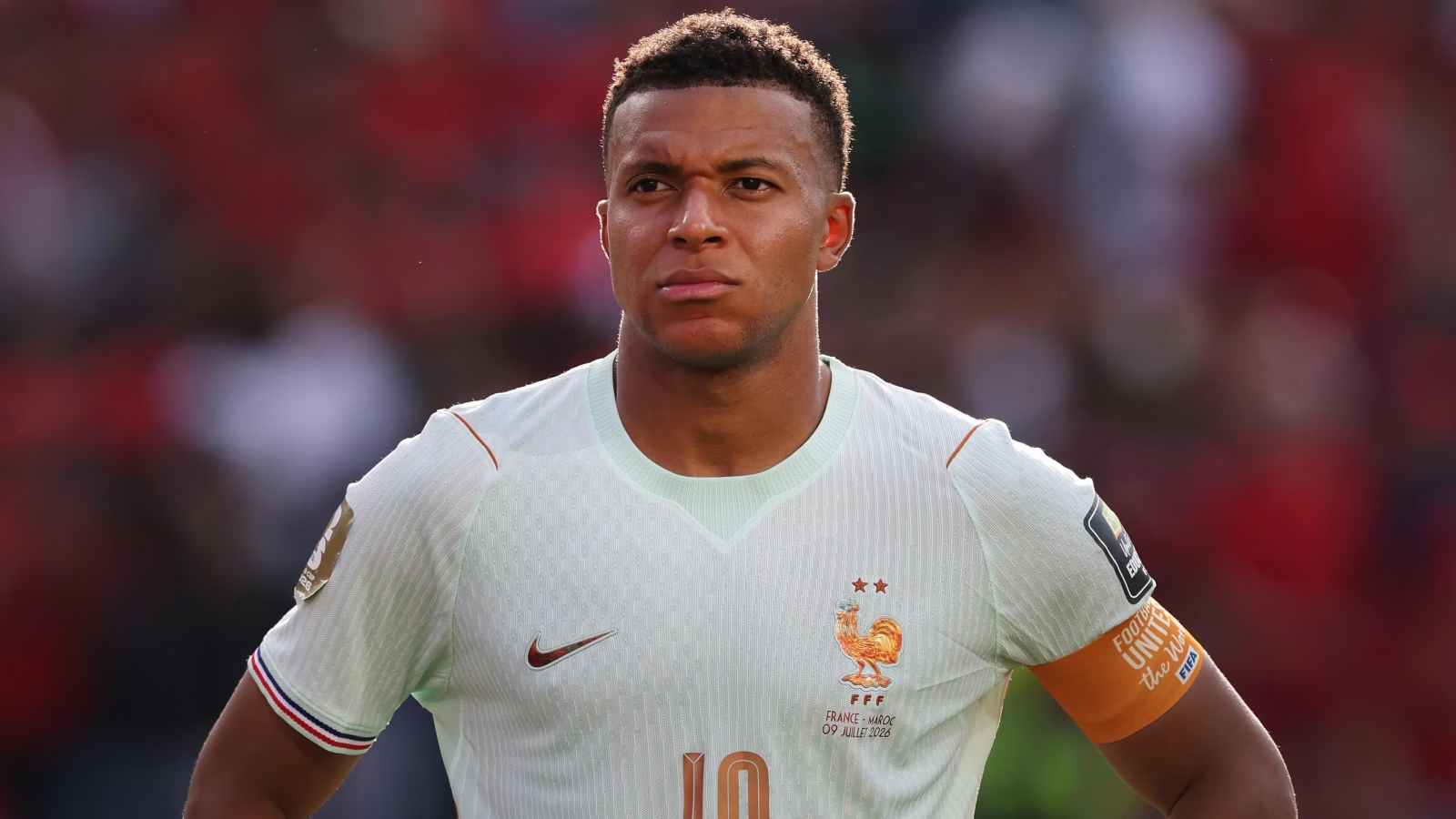
Kylian Mbappe and Lionel Messi have quickly re-established themselves as the defining figures of World Cup 2026, with the tournament’s opening narrative already shaped by their parallel starts and their enduring rivalry from the 2022 final. France and Argentina have both begun their campaigns with the spotlight fixed firmly on their leading stars, and the numbers have only sharpened that focus. Mbappe reached 14 men’s World Cup goals to move past Just Fontaine and ahead of Messi’s tally at that stage, only for Messi to respond later by taking his own total to 16. That sequence has given the tournament an immediate sense of continuity, linking this edition of the World Cup to the biggest individual storylines of the last one.
- Kylian Mbappe reached 14 men’s World Cup goals during France’s opening 2026 World Cup campaign.
- That mark moved Mbappe past Just Fontaine in the men’s World Cup scoring charts.
- Mbappe’s total also put him ahead of Lionel Messi’s 13 goals at that point in the tournament narrative.
- Lionel Messi later responded by taking his own men’s World Cup goal tally to 16 during Argentina’s opening 2026 World Cup campaign.
- The Messi-Mbappe comparison from the 2022 World Cup final has carried directly into the early stages of the 2026 tournament.
A rivalry that needed no reintroduction
What makes this storyline so compelling is not simply that two elite forwards are scoring again on the biggest stage. It is that their World Cup journeys remain intertwined in a way that feels unusually direct for players from different generations. The 2022 final established a reference point that remains impossible to ignore, and the opening days of 2026 have revived that connection almost immediately. Every step forward by Mbappe now seems to invite a response from Messi, and every Messi milestone heightens the significance of Mbappe’s own progress.
Mbappe’s move to 14 World Cup goals is significant on its own because it takes him beyond Just Fontaine, one of the most iconic names in World Cup scoring history. That is a landmark with real weight in French football and in the broader history of the competition. It also underlines how quickly Mbappe has built a scoring record that already belongs alongside the game’s most celebrated tournament specialists. Even without any embellishment, the fact that he moved beyond Fontaine and briefly stood ahead of Messi in the running total gave France’s opening chapter a distinct sense of historical momentum.
Messi’s response was just as important because it prevented that momentum from becoming a one-sided story. By moving to 16 World Cup goals, he restored his own advantage and reminded everyone that his place in tournament history remains active rather than merely commemorative. That matters in a World Cup setting, where legacy is often discussed as though it is fixed long before a ball is kicked. Messi has ensured that the conversation remains alive, and in doing so he has turned the early rounds of this tournament into a live contest of accumulation, endurance and influence.
What it means for France, Argentina and the tournament
For France, Mbappe’s milestone offers more than a personal achievement. It reinforces the sense that their campaign still runs through a forward capable of turning every match into a historic occasion. When a team opens a World Cup with a player climbing major all-time charts, the emotional effect can be as significant as the tactical one. Opponents know they are facing not only a dangerous attacker but also a footballer operating in rarefied statistical territory, and that can shape the way matches are approached before they even begin.
Argentina, meanwhile, benefit from a different but equally powerful dynamic. Messi’s rise to 16 World Cup goals gives their campaign an immediate anchor point, a reminder that his influence on the competition remains current and measurable. In tournament football, where margins are often narrow and pressure rises with every round, that kind of certainty around a central figure can be invaluable. Argentina’s opening phase now carries the reassurance that their captain is still adding to his record, still defining moments, and still forcing the wider tournament to revolve around his output.
The broader significance is that World Cup 2026 has acquired a clear narrative thread very early. International tournaments often begin with scattered themes, with different groups and contenders developing their own separate stories before a dominant one emerges. Here, the contrast and comparison between Mbappe and Messi arrived almost immediately because the milestones were concrete and sequential. Mbappe surged to 14 and beyond Fontaine; Messi then pushed on to 16. Those facts are enough to create a compelling framework for the weeks ahead, especially because they connect present performance to long-running debates about greatness, longevity and decisive impact on football’s biggest stage.
There is also an important contrast in what each player represents at this point in the competition. Mbappe’s numbers speak to acceleration, to the idea of a player still building a World Cup body of work at remarkable speed. Messi’s numbers speak to extension, to a player continuing to stretch an already extraordinary record. That tension gives the storyline its shape. One is charging upward through the historical rankings, while the other continues to defend and expand his place near the summit. The result is a race that lends extra meaning to every appearance.
It is worth keeping the focus on what can be firmly established. The available facts support the conclusion that the Messi-Mbappe comparison remains central to the tournament’s early rhythm, and they show clearly how each player has advanced his World Cup scoring total. They do not require exaggeration to feel important. The milestones themselves, combined with the memory of the 2022 final and the simultaneous starts by France and Argentina, provide more than enough substance to explain why attention has settled so quickly on these two names again.
What comes next is the most intriguing part. Every further France match will present Mbappe with another chance to narrow the gap or reclaim the edge in this running duel, while every Argentina outing gives Messi the opportunity to push his total further clear. That does not guarantee the rest of World Cup 2026 will belong exclusively to them, but it does mean the tournament already has a powerful storyline carrying it forward. As the knockout pressure draws closer and the stakes rise, the race between Mbappe’s ascent and Messi’s enduring command looks set to remain one of the defining themes of the competition.
Leave a Reply