

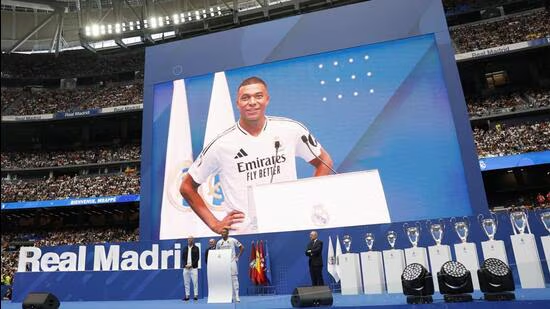
The moment many had anticipated has finally arrived: Kylian Mbappe, the world’s most valuable football player, has been officially introduced as a Real Madrid player. This high-profile addition comes a year after Jude Bellingham’s arrival, marking a new era of young and dynamic talent at the club.
Real Madrid president Florentino Perez, known for his pursuit of footballing superstars, welcomed Mbappe, a move that signals the potential beginning of a third phase of the Galacticos era. The term “Galacticos,” coined by Perez at the turn of the century, refers to Real Madrid’s strategy of signing the world’s biggest football stars. This era initially launched with the acquisition of Luis Figo in 2000, a transfer that was both groundbreaking and controversial, as Figo moved from arch-rival Barcelona for a then-record fee of 60 million euros.
Following Figo, Real Madrid continued its Galacticos policy with the signing of French playmaker Zinedine Zidane, who also became a Real legend. The policy continued through Perez’s first tenure (2000-2006) and resumed in his second term starting in 2009. During these periods, the club brought in stars like David Beckham, Ronaldo, Kaka, and Cristiano Ronaldo. This era saw Real Madrid dominate the top transfer charts, with five of the top 10 most expensive transfers during the decade going to the club.
However, the dynamics of European club football have shifted in recent years. With the rise of English clubs and their lucrative media rights deals, the financial landscape has changed significantly. Between 2010-11 and 2019-20, Real Madrid’s top transfer acquisitions dwindled to just Gareth Bale and Eden Hazard, while other clubs like Barcelona, Paris Saint-Germain (PSG), and Juventus also made significant signings. Despite high transfer fees, many of these players struggled to make a lasting impact.
In the 2000s, Real Madrid was the top spender in the transfer market, investing 959 million euros, significantly more than its rivals. In contrast, over the past decade, the club’s spending power has diminished, ranking seventh and then eleventh in the current decade, even with the potential 180 million euros for Mbappe that was previously reported. English clubs, in particular, have matched and sometimes surpassed Real Madrid’s spending.
Despite these changes, Real Madrid retains an unmatched historical and symbolic value, akin to iconic sports teams like the West Indies cricket team of the 1980s or the New York Yankees. The club remains the world’s top football club by revenue, recently reclaiming the top spot from Manchester City.
The additions of Mbappe and Bellingham position Real Madrid to start a new chapter in its Galacticos legacy. The club continues to combine its storied history with a fresh wave of talent, positioning itself to remain a dominant force in global football.



Leave a Reply