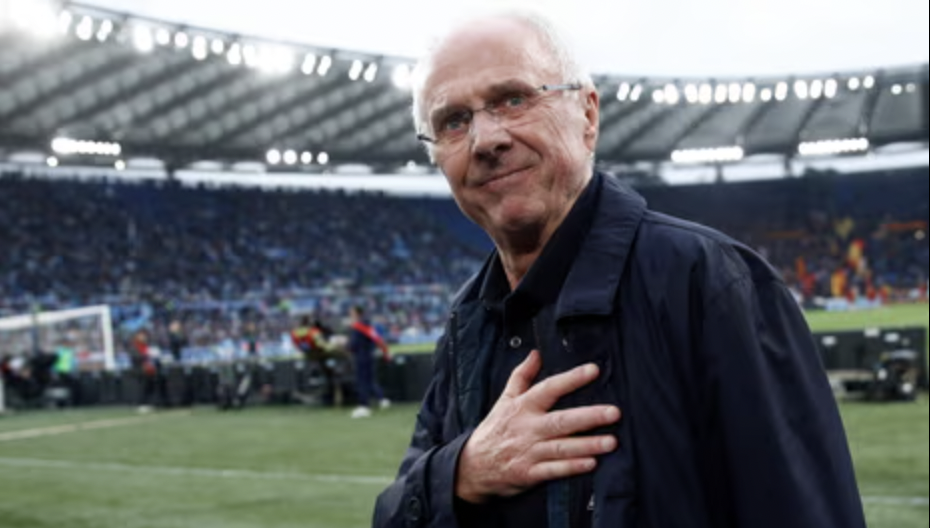
Sven-Göran Eriksson, the pioneering manager who became England’s first overseas coach and a highly respected figure in football, has passed away at the age of 76.
In January 2024, Eriksson revealed his terminal cancer diagnosis, estimating that he had “at best” about a year to live. He had stepped down from his last role as sporting director at Karlstad, in his native Sweden. The previous February, citing “health issues which are under investigation.”
Eriksson’s agent in Sweden, Bo Gustavsson, confirmed news of his passing through UK PR representative Dean Eldredge of Oporto Sports. The statement noted that Eriksson passed away peacefully at home on Monday morning. Surrounded by his family, who requested privacy during this difficult time.
Eriksson’s managerial career, which spanned over four decades, was marked by numerous successes. He began his journey in Sweden with Degerfors IF before taking the reins at IFK Göteborg. Despite being relatively unknown at the time, Eriksson, then 30, quickly proved his worth. Leading Göteborg to a Swedish title and a UEFA Cup victory in 1982.
His success in Sweden caught the attention of Benfica, where Eriksson continued to excel. Securing two league titles and reaching the UEFA Cup final in 1983, although his team narrowly lost to Anderlecht. Eriksson’s star continued to rise as he managed prestigious clubs like Roma, Fiorentina, and Sampdoria, where he won the Coppa Italia in 1994. His crowning achievement at club level came with Lazio, where he led team to a Serie A title in 2000. Their second in history, backed by the club’s wealthy president, Sergio Cragnotti.

By January 2001, when the Football Association approached Eriksson to succeed Kevin Keegan as England’s manager. He had already earned respect as one of Europe’s top coaches. However, controversy greeted his appointment, especially from certain segments of the British media, who questioned the decision to hire a foreign manager. Despite the criticism, Eriksson remained composed and led England to a resounding 3-0 victory over Spain in his debut match.
The thrilling 5-1 victory over Germany in Munich in September 2001 is perhaps the most memorable moment of Eriksson’s tenure as England manager. The result, described as “ecstasy in spades” by the Guardian’s David Lacey. Marked a high point in Eriksson’s career, solidifying his reputation as a master tactician.
Despite guiding England to three consecutive quarter-finals in major tournaments, critics often accused Eriksson of failing to fully capitalize on the potential of England’s so-called “golden generation.” Off-field controversies also marred his tenure, including his high-profile affair with television presenter Ulrika Jonsson and a tabloid sting in 2006 that revealed him discussing a potential move to Aston Villa. The cumulative effect of these incidents made his position untenable. Leading to the announcement that he would leave his post after the 2006 World Cup.
Reflecting on his time with England, Eriksson later remarked, “The unfair thing is not the football press. The unfair thing is rest of the press, which can’t see difference between your private life and your professional life.”

After leaving England, Eriksson continued to manage various clubs and national teams, including stints at Manchester City, Leicester City, Mexico, and, most recently, the Philippines in 2019. In March 2024, he fulfilled a lifelong dream by managing Liverpool in a charity match at Anfield, which he described as “a beautiful day.”
A documentary about Eriksson’s life, simply titled “Sven,” was released on Amazon Prime before his passing. In it, Eriksson offered a poignant message that captured his trademark humor, grace, and dignity: “Don’t be sorry, smile. Thank you for everything—coaches, players, the crowds—it’s been fantastic. Take care of yourself and take care of your life. And live it. Bye.”
Eriksson leaves behind a legacy as a trailblazer, a manager who not only achieved great success but also navigated the challenges of being a foreign coach in one of football’s most scrutinized positions. His impact on the sport will be remembered for generations to come.
