


Williams’ recent upgrades showed significant potential during practice and qualifying, with Alex Albon’s impressive performance securing a spot in Q3. Team principal James Vowles noted the positive impact of these revisions, stating, “We’re in a situation where that update is producing good results, and in a very tight midfield we’re able to put the car back into that Q3 position.”
Vowles also highlighted the upgrades’ effectiveness during long runs, with the car performing competitively against teams like Ferrari. A notable improvement from earlier in the season.
However, Williams’ promising weekend hit a major setback when a measurement error led to the team running a new floor that was non-compliant with regulations. Although the issue was easily rectified, the team faced a significant disadvantage. Starting from the back of the grid for both cars due to the problem and Logan Sargeant’s practice crash. Consequently, the opportunity to score points was lost, turning the weekend into a missed chance.
Despite this frustration, Williams is keen to see if the early success at Zandvoort can be replicated in upcoming races. Here’s a closer look at the recent changes made to Williams FW46, which focus on aerodynamic improvements and weight reduction.
The most noticeable change is the new sidepod design. Williams has transitioned from an underbite-style inlet to an overbite extension panel with an under-slung inlet. This adjustment aligns with industry trends, allowing for greater aerodynamic freedom while maintaining necessary cooling performance. The new design features larger inlets beneath the higher top lip of the sidepod.
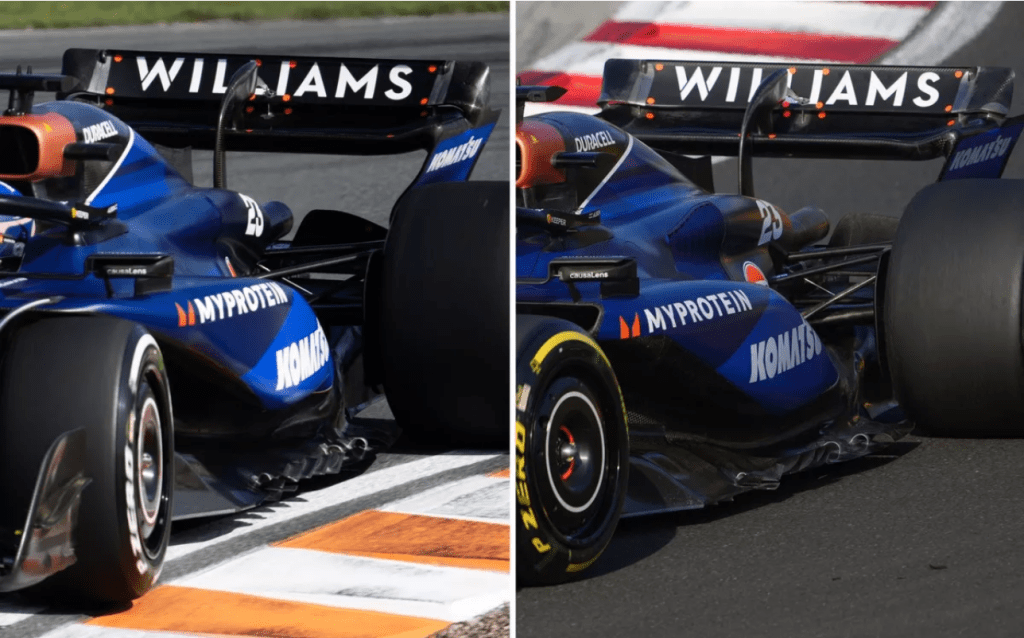
Additional bodywork changes include a less aggressive upper gully and a more pronounced undercut. The redesign of the sidepod’s flank features a raised beltline and a narrower underbelly, adopting a more aggressive geometric profile.
Modifications to the floor and floor wing are also significant. The upswept section of the edge wing is now more pronounced, with deeper and more defined separating strakes compared to previous versions.
The team has also focused on weight reduction, particularly around the roll hoop. Alterations to the airbox shape and internal spars are part of this effort. Chief Technical Officer Pat Fry explained, “There are some tiny detail changes on the aero shape around the shrouds and the ducting into the central radiator, but that’s all just chasing weight out of the car.”
Fry acknowledged that while the car is now lighter, it remains slightly overweight. He added, “We’ve got a few more updates coming later in the year, which will hopefully get us right down on the weight limit.”
Despite the setback at Zandvoort, Williams remains optimistic about the potential of their upgrades and their impact on future performances.

Leave a Reply