

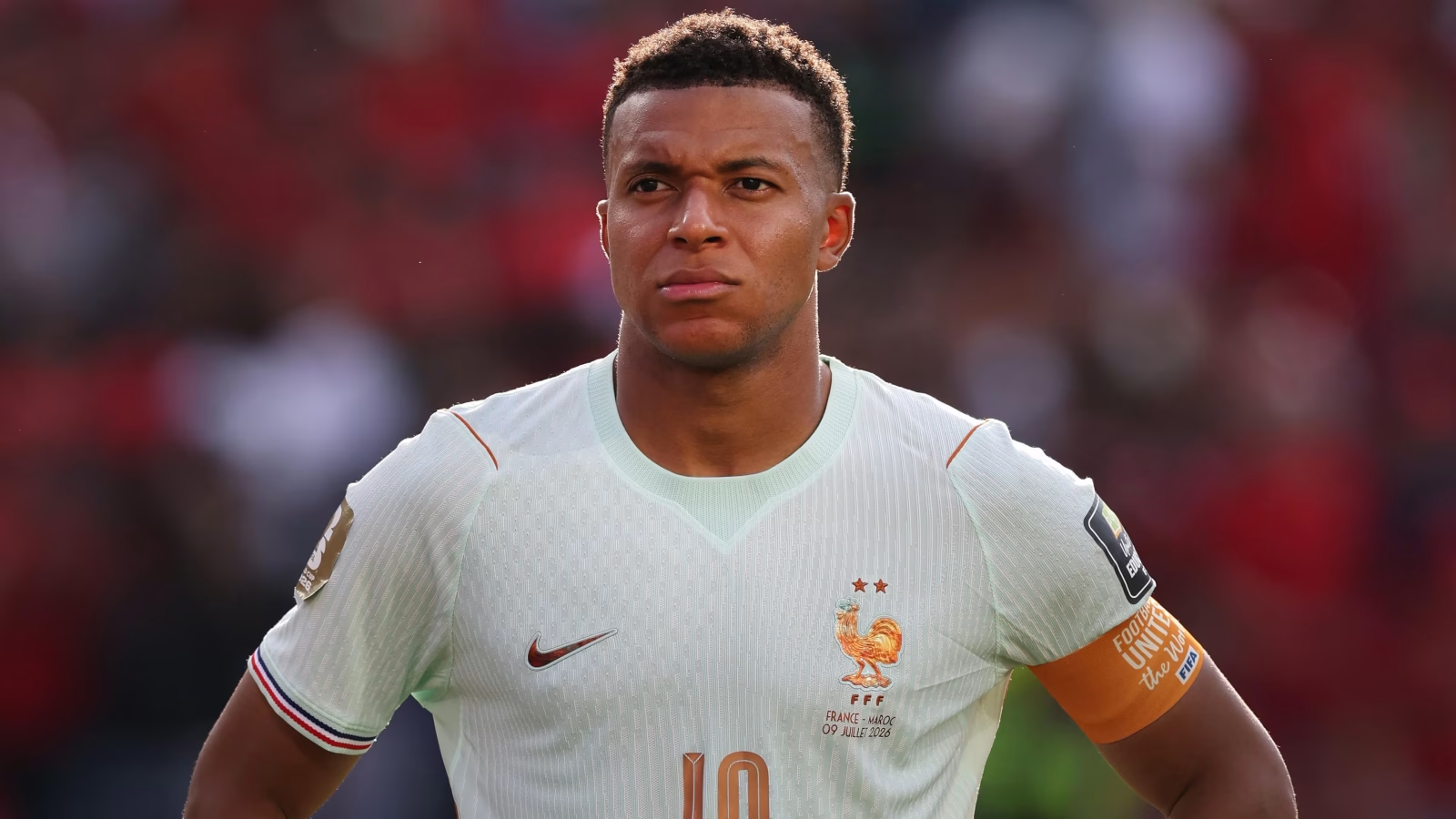
The 2026 FIFA World Cup knockout stage is coming into sharper focus, with the route to the final now the central storyline as teams and supporters map the path to 19 July. At this stage, the standout figure is not an individual player but the bracket itself, because every confirmed pairing and projected crossover now carries major significance in shaping the tournament’s closing weeks. What has been verified so far is enough to underline the scale of what lies ahead: the knockout phase runs from the Round of 32 through the Round of 16, quarter-finals, semi-finals, a third-place match and the final. Within that framework, England are set to face Norway in a quarter-final, while France are involved in a quarter-final against Morocco on Thursday, 9 July, giving two major ties immediate importance.
- The 2026 World Cup knockout bracket covers the Round of 32, Round of 16, quarter-finals, semi-finals, a third-place match and the final.
- The route through the knockout stage leads to the World Cup final on 19 July 2026.
- England are set to play Norway in a quarter-final.
- Argentina are a possible semi-final opponent for England if that quarter-final route holds.
- Morocco and France are involved in a quarter-final on Thursday, 9 July.
- If France advance, they would face the winner of Spain versus Belgium.
How the bracket is beginning to define the tournament
The most significant development is that the tournament has moved beyond broad knockout speculation and into a more meaningful discussion about pathways. Once the bracket is visible from the Round of 32 all the way to the final, each team’s prospects are shaped not only by the next match but by the sequence of opponents that could follow. That shifts the conversation from isolated fixtures to the wider architecture of the competition. In a World Cup of this scale, the bracket becomes a competitive map, and the teams best placed to navigate it are often those capable of balancing immediate execution with an awareness of what the next round may demand.
England’s quarter-final against Norway stands out because it provides a defined point on one side of the draw while also hinting at the level of challenge that may come next. The possibility of Argentina waiting in a semi-final adds immediate gravity to England’s route, even before that stage is reached. For England, the quarter-final cannot be viewed as a single hurdle in isolation; it is part of a sequence that could escalate quickly in difficulty. For Norway, the same logic applies, because victory would not only secure a place in the last four but also open the door to one of the tournament’s biggest potential semi-final occasions.
That makes the quarter-final stage especially compelling. By this point in a World Cup, margins are already thin, and the bracket can intensify the pressure because teams know exactly what is at stake beyond the next 90 minutes. England versus Norway is therefore significant not only because of the immediate prize of a semi-final place, but also because the possible Argentina link gives the tie broader tournament consequences. Even without a fully verified list of all quarter-final pairings, this single branch of the bracket already shows how the knockout phase can gather momentum and narrative force at the same time.
More broadly, that is where the bracket begins to shape the identity of the tournament. Group-stage football is often about accumulation, adjustment and survival; knockout football is about consequence. Once the draw narrows and the pathways become clearer, every fixture starts to carry a double meaning, deciding both the immediate result and the next layer of pressure. That is why even partial confirmation of the bracket matters so much. It allows the tournament to be read not simply as a list of matches, but as an unfolding route in which each branch can quickly become decisive.
France, Morocco and the pressure of the next step
On another branch of the bracket, the confirmed involvement of Morocco and France in a quarter-final on Thursday, 9 July, creates a similarly high-stakes scenario. A quarter-final is always a defining match, but this one carries an extra layer because the next step is also partially visible. If France advance, they would meet the winner of Spain versus Belgium, a detail that immediately places the tie within a larger competitive context. Rather than treating the quarter-final as the end of one chapter, both teams must approach it as the gateway to a potentially even more demanding semi-final test.
For France, that projection sharpens the challenge in two ways. First, there is the immediate task of getting past Morocco, which is substantial enough on its own in a World Cup quarter-final. Second, there is the knowledge that progress would not bring relief, only another elite-level confrontation against either Spain or Belgium. That kind of route can influence how a side manages the match, because efficiency, control and emotional discipline become just as important as ambition when the bracket promises no let-up.
Morocco, meanwhile, can draw significance from the same structure. A quarter-final against France is already one of the major fixtures of the round, and the bracket gives it even greater consequence because the winner steps directly into a semi-final with a clearly defined next opponent. That clarity can be a source of motivation as much as pressure. In knockout football, teams often gain energy from knowing that one result can transform their entire tournament, and this tie sits squarely in that category.
What remains notable is how much intrigue exists even with only partial confirmation of the quarter-final picture. The verified details do not provide a complete list of the last-eight matchups, so any broader reconstruction of the full bracket would go beyond what is established. Yet the confirmed elements are enough to show the tournament tightening into a series of heavyweight intersections. England’s route toward a possible Argentina meeting, and France’s route through Morocco toward the winner of Spain versus Belgium, give the knockout stage a strong competitive outline without requiring unsupported detail.
That matters because the World Cup is often defined by the balance between certainty and possibility. At this stage, certainty comes from the structure itself: the tournament runs through the Round of 32, Round of 16, quarter-finals, semi-finals, third-place match and final, culminating on 19 July 2026. Possibility comes from the branches that are now opening, where one win can redirect the entire story of a campaign. The bracket is therefore doing exactly what a World Cup knockout draw should do: compressing the field, clarifying the stakes and turning every confirmed matchup into part of a much larger race for the final.
As the tournament moves deeper into its decisive phase, attention will remain fixed on how these confirmed pathways develop. England’s meeting with Norway carries the added intrigue of a possible Argentina semi-final beyond it, while France and Morocco face a quarter-final that feeds into a potential clash with Spain or Belgium. The broader knockout structure is set, the destination is clear, and the final on 19 July now feels close enough for every remaining branch of the bracket to matter. From here, each result will not only decide who advances, but also reshape the road to the biggest match of all.



Leave a Reply