
How was 2024 for you? Exciting, disappointing, fun, tactically intriguing, or perhaps a waste of environmental resources? There’s a spectrum of valid responses to this question. However, for the football fans depicted in advertisements—who were bombarded with ads for TVs, betting, specs, hybrid vehicles, Scottish fizzy drinks, sportswear, holidays, razors, and beer, led by Sir Geoff Hurst—answers are far less expansive.
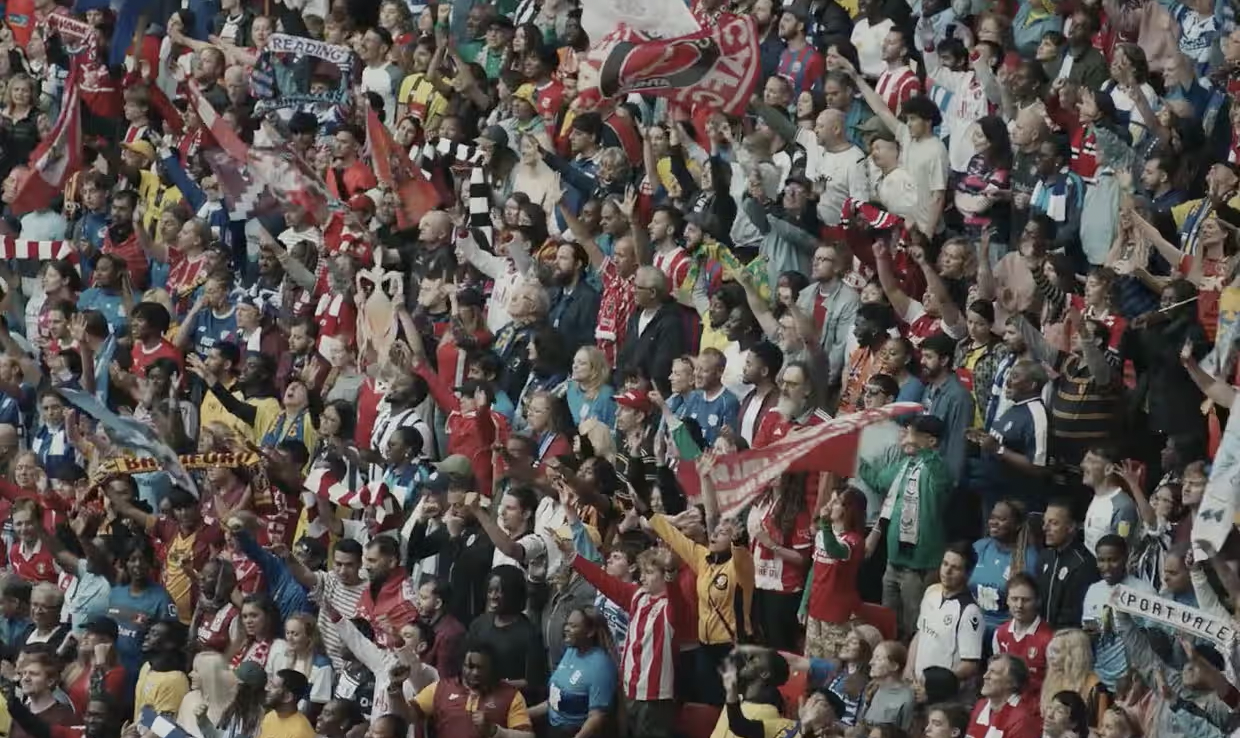
Advertising often portrays football fans in a narrow and stereotypical manner. They are usually male, though the industry has acknowledged football’s significant female audience. They are predominantly white, although there has been some attempt at diversity. Most importantly, advertisers almost always show these fans wearing replica shirts and exhibiting a binary range of emotions: joy or despair.
In the advertising world, football fans oscillate between cheerfulness and desolation. They are depicted as easily pleased, whether by a two-for-one pizza offer or cheaper holiday insurance, often cheering in unison like the audience on “Fantasy Football League.” Defeat reserves desolation, which people mitigate with a slice of discounted pizza or a swig of premium beer—consumed responsibly, of course.
Ads depict footballers as near-superhuman, impossibly handsome, and espousing high-performance philosophies. In contrast, ads never depict fans as sophisticated. While it’s unrealistic to expect deep characterisation in ads, the industry could acknowledge that football attracts a diverse cross-section of society. On a train to a Premier League match, you might encounter a wide range of people, from circuit judges to petty criminals.
David Beckham, Thierry Henry, and Lionel Messi’s recent cheesy Lay’s potato crisps commercial used fans for their cheering capabilities alone. “Henry, Beckham, and Messi bring so much authenticity to what they do,” said Ciara Dilley, global VP of Lay’s. “The three all exude positivity, fun, and joy, all things that Lay’s brand represents.” However, this view is unlikely to be universally shared by fans. The advertising world often skips over football’s deep-seated rivalries and tribalism, except when monetising passion and loyalty.

Broadcasters can be particularly guilty of patronising a homogenous collective while acting against their interests. Sky Sports’s 1996 advert, featuring Sean Bean, declared: “It’s ecstasy, anger, joy, and despair. It’s theatre, art, war, and love. It should be predictable but never is. We know how you feel about football because we feel the same.” Fans who find themselves traveling across the country for a Monday night game due to a Sky TV schedule might disagree.
Sky heavily advertised its new channel, Sky Sports+, during the Euros. The ad featured a crowd singing “Up Where We Belong,” with a stereotyped collection of fans sharing moments of passion. However, this new deal means more matches at inconvenient times, contributing to the decline of the traditional 3pm Saturday kick-off. In advertising, as “Mad Men’s” Don Draper said, “happiness” is the goal, and reality is often the first casualty. Football supporters, facing rising ticket prices, are among the most abused consumer groups.
Considering that 24.2 million viewers watched the Euro 2024 final, football supporters deserve better representation than the one-dimensional cheering and jeering figures the advertising industry persists with.