

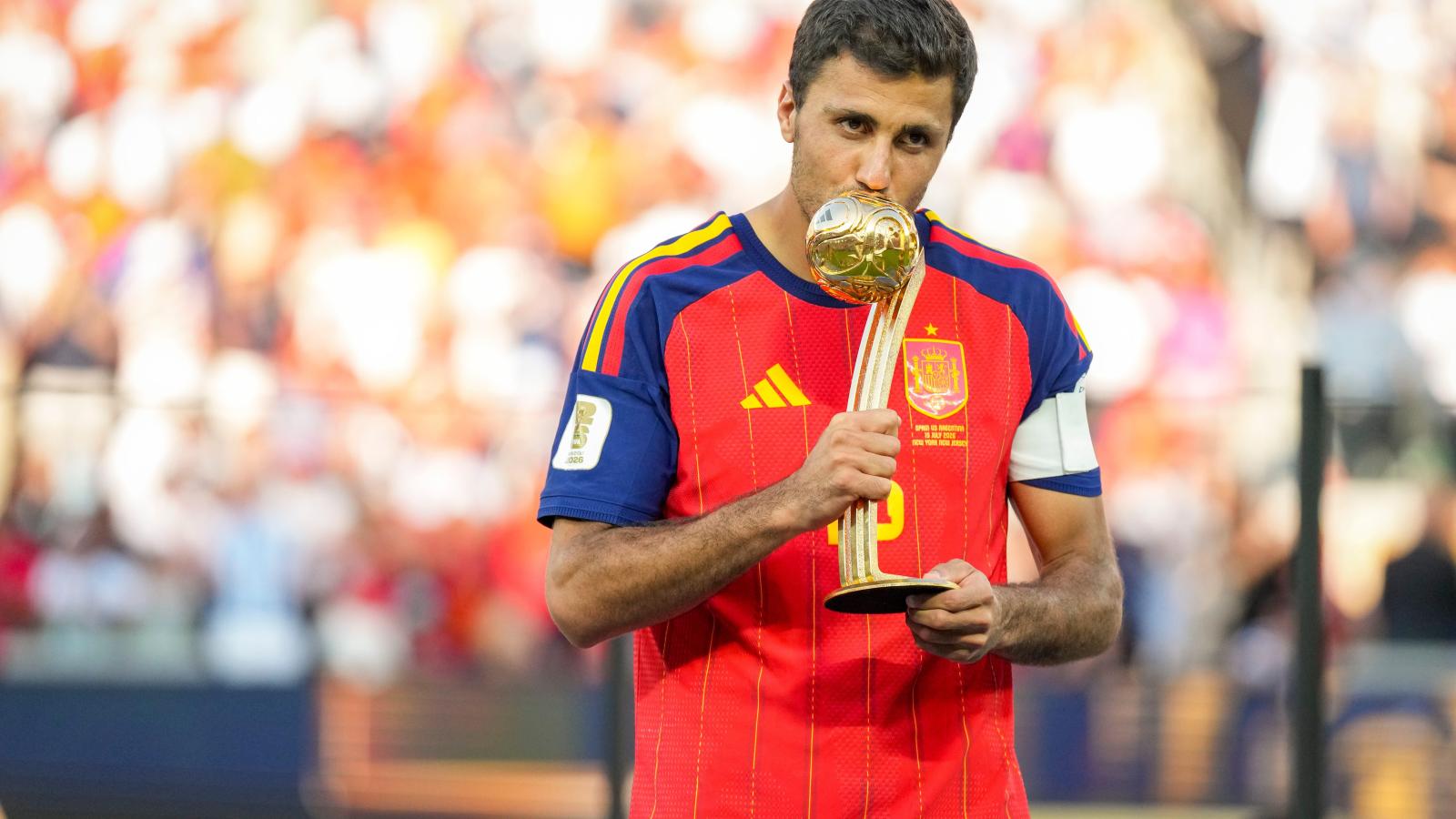
Spain’s World Cup campaign is developing against the backdrop of a significant fitness concern involving Rodri, with the midfielder expected to undergo surgery on a back issue after the 2026 tournament. The development matters not only because of Rodri’s importance to Spain’s structure, control and rhythm, but also because it raises immediate questions over how he will be managed through the closing stages of the competition and what comes next once the World Cup ends. The procedure is expected to be minor, yet the absence of a confirmed recovery timetable leaves uncertainty over both his short-term workload and his availability beyond the summer. For a player whose presence so often dictates the tempo of a match, that uncertainty has become one of the most important fitness stories of the tournament.
- Rodri is expected to undergo surgery on a back issue after the 2026 World Cup.
- The planned procedure is described as a minor operation.
- There is no confirmed return date for the midfielder at this stage.
- He could miss pre-season and the opening part of Manchester City’s 2026-27 campaign.
- A final decision on when he will return to action has not yet been made.
Why this matters for Spain
Rodri’s situation arrives at a delicate stage of the tournament because players in his position are often asked to carry the heaviest tactical burden. He is the kind of midfielder who connects defensive security with attacking progression, and any physical issue that affects mobility, sharpness or durability can alter the balance of an entire side. Even when a player remains available, the knowledge that surgery is scheduled for immediately after the World Cup inevitably changes the discussion around load management, recovery between matches and the risks attached to extended minutes. Spain therefore face a familiar tournament challenge in a more specific form: how to keep one of their most influential players effective without exposing him to unnecessary danger.
The fact that the operation is expected to be minor offers some reassurance, but it does not remove the uncertainty. In elite tournament football, the difference between a manageable issue and a limiting one can show up in the smallest details, from the intensity of pressing to the speed of turning away from pressure. Midfielders operating in central areas are repeatedly drawn into duels, transitions and circulation phases, which means they rarely get a quiet game. That is why even a relatively modest procedure becomes major news when it concerns a player expected to anchor a side with ambitions of going deep into the World Cup.
There is also a psychological layer to the story. Teams in knockout football always try to project calm, but they are equally aware of how quickly injury concerns can reshape plans. Knowing that Rodri is set for surgery after the tournament may not alter Spain’s intentions in possession, yet it inevitably sharpens the focus on squad depth, rotation options and in-game management. If Spain are to maintain control in the biggest matches, they will need the midfield unit around him to absorb more of the physical and creative responsibility rather than leaving one player to carry the full strategic load.
The wider club impact after the tournament
Beyond the World Cup itself, the implications for Manchester City are significant because the current expectation is that Rodri could miss pre-season and the opening part of the 2026-27 campaign. That possibility matters on two levels. First, pre-season is where teams rebuild rhythm, conditioning and tactical timing after the summer break, and missing that period can complicate a player’s reintegration even after a minor procedure. Second, the beginning of a league season often sets the tone for the months ahead, so any delay in his return would force early adjustments in midfield planning.
The uncertainty over the timetable is the key detail. There is still no determined return date, and no final decision has been made on when Rodri will be back in action. That leaves a broad range of possibilities, from a relatively swift recovery to a more cautious process shaped by how he responds after surgery. In practical terms, it means there is currently no fixed point around which to build expectations, and that ambiguity is often as important as the injury itself because it affects preparation, selection planning and the management of the player’s workload once he is cleared to train again.
For Manchester City, the concern is not simply the loss of a talented midfielder for a short period. Rodri’s role is usually tied to control, structure and defensive balance, qualities that influence every phase of a match. When a team is built around a player who dictates tempo and protects the spaces in front of the defence, even a temporary absence can have wider tactical consequences. That is why the prospect of missing pre-season and the early part of the campaign stands out so sharply: it is not just about replacing minutes, but about preserving the coherence of the side during a period when patterns are usually being re-established.
From Rodri’s own perspective, the timing is awkward, even if it is not unusual in modern football, where major international tournaments often compress the calendar and leave little room for ideal recovery windows. Finishing a World Cup and then moving straight into surgery creates a demanding transition from competitive intensity to rehabilitation. Even if the procedure is minor, the challenge lies in balancing the need for proper healing with the pressure to return for club football as soon as possible. Without a confirmed schedule, the sensible reading is that caution will shape the next steps rather than any rush to set a target that may later need to be revised.
This also places extra attention on how the final stages of the World Cup are navigated. Every additional match in the tournament adds emotional and physical strain, particularly for players in central positions who are involved in almost every phase of play. Spain will want Rodri’s authority and composure for as long as they remain in the competition, but the longer the run, the tighter the turnaround becomes before treatment and recovery begin. That tension between immediate ambition and medium-term fitness is part of what makes this story so important: it sits at the intersection of a nation’s tournament hopes and a club season already beginning to take shape in the background.
What comes next is clear in broad outline, even if the timetable is not. Rodri is expected to complete the World Cup before undergoing the planned operation on his back issue, after which the focus will shift to rehabilitation and a decision on when he can safely return. Spain will continue to rely on his influence while the tournament lasts, but the discussion around him now extends well beyond any single match. Once the World Cup ends, attention will quickly turn to surgery, recovery and whether he can avoid missing too much of the opening stretch of Manchester City’s next campaign.
Leave a Reply