

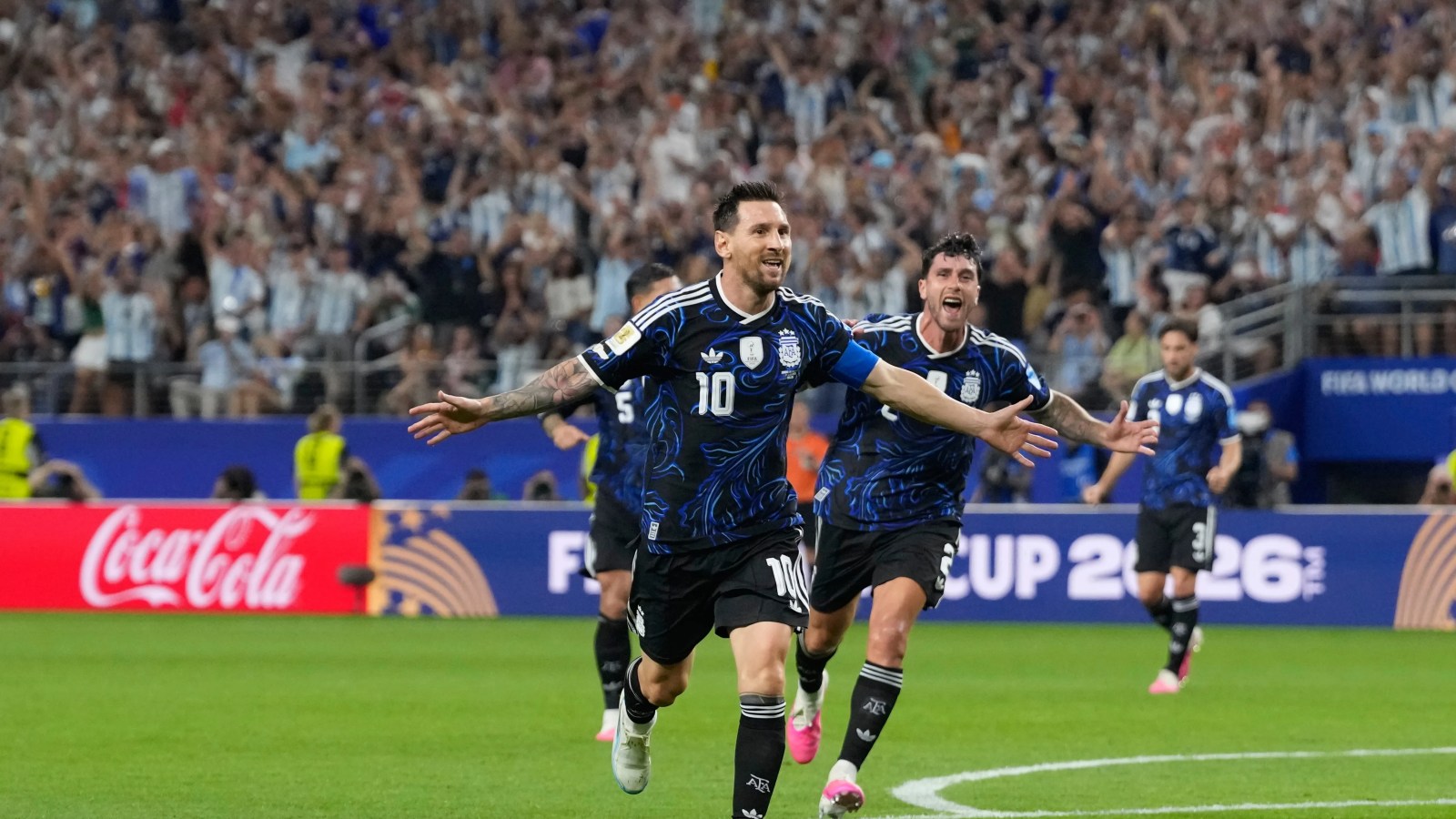
Lionel Messi set the tone for a gripping World Cup night in Miami by scoring the opener for Argentina against Cape Verde, in a knockout tie that quickly grew into one of the tournament’s most dramatic contests. What began with a familiar flash of quality from Argentina’s captain developed into a tense, back-and-forth battle against a Cape Verde side that has earned surprise-package status on this stage. The confirmed match details show that Argentina later moved back in front during extra time, underlining just how fiercely contested the evening became. Even without the full verified scoring sequence or final score, the significance was unmistakable: Messi’s early intervention launched a high-stakes encounter that tested Argentina’s authority and highlighted Cape Verde’s refusal to fade.
- Lionel Messi scored the opening goal in Argentina’s World Cup knockout match against Cape Verde in Miami on July 3, 2026.
- The match developed into a thriller, with momentum shifting enough to require extra time.
- Argentina later went back in front during extra time in a key turning point of the night.
- One verified match reference identifies that moment as Argentina’s third goal of the game.
- Cape Verde’s role in the contest reinforced its standing as one of the tournament’s surprise packages.
Messi sets the stage in a tense knockout battle
Messi’s opener mattered for more than the scoreboard. In knockout football, the first goal often shapes the emotional temperature of the entire contest, and Argentina would have expected a breakthrough from their most influential player to settle nerves and establish control. Instead, the match evolved into a thriller, suggesting Cape Verde responded with conviction rather than shrinking under the pressure of the occasion. That reaction is central to understanding the night in Miami: Argentina had the star power and pedigree, but Cape Verde had the resilience to keep the tie alive deep into the contest.
The fact that the game extended into extra time says plenty about the challenge Argentina faced. Knockout matches can become increasingly cautious as tension rises, yet this one appears to have retained its edge and unpredictability well beyond the opening exchanges. Argentina eventually going back in front during extra time points to a contest that demanded patience, concentration and emotional control from a side expected to handle the biggest moments. It also suggests Cape Verde forced Argentina into a far more complicated evening than many would have anticipated when Messi opened the scoring.
That detail alone gives the match its shape. An early goal from Messi should have provided the platform for a more controlled performance, particularly from a team carrying Argentina’s expectations and tournament weight. Instead, the tie became a test of endurance and nerve, with momentum shifting often enough to prevent Argentina from settling into a rhythm. In that sense, Messi’s contribution was both the opening statement and the starting point of a much longer struggle than the favourites would have wanted.
For Argentina, there is significance in the timing as much as the quality. To score first in a knockout tie and still be dragged into extra time points to an opponent capable of disrupting patterns, challenging confidence and extending pressure. That is what makes the eventual extra-time lead so important. It was not simply another goal; it was a response to a match that had become increasingly unstable and emotionally demanding.
Cape Verde’s rise gives the contest its edge
Cape Verde’s description as a surprise package is not a decorative label; it is the key piece of context that explains why this fixture became so compelling. Teams that carry that status into the knockout rounds usually do so by combining organisation, belief and a willingness to embrace difficult moments, and this match appears to have reflected exactly those qualities. Rather than being overwhelmed by Argentina’s reputation or by Messi’s early strike, Cape Verde stayed in the fight long enough to push one of the tournament heavyweights into extra time. That alone marks the scale of their performance and shows why they have captured attention during this World Cup.
From Argentina’s perspective, the match was a reminder that knockout football rarely follows a script, even when a superstar lands the first blow. Messi’s opener could have been the beginning of a controlled, efficient display, but the verified details point instead to a game that became stretched, dramatic and increasingly difficult to manage. When a team has to go back in front during extra time, it usually means the opposition has repeatedly found ways to disrupt rhythm and belief. Argentina’s ability to produce that decisive response under pressure matters, because tournaments are often defined not only by dominance but by how contenders survive the nights when control slips away.
The mention of Argentina’s third goal of the night adds another important layer to the story. Even without a fully confirmed scoring sequence or final score, that detail indicates the game contained multiple swings and enough attacking action to keep the outcome uncertain for long periods. For Argentina, reaching a third goal in such a contest points to persistence and attacking quality at a moment when fatigue and pressure can blunt decision-making. For Cape Verde, being involved in a knockout match of that intensity against Argentina further strengthens the impression of a team capable of stretching elite opposition and refusing to be defined by underdog status alone.
Miami provided a fitting backdrop for a match that appears to have blended star power with genuine jeopardy. Argentina arrived with one of the game’s most recognisable figures and with the burden of expectation that follows every knockout appearance, while Cape Verde brought the energy and unpredictability of a side enjoying a breakthrough run. Those ingredients often create compelling football, and the verified details suggest exactly that happened here. Messi supplied the headline moment at the start, but the broader story was the way Cape Verde helped turn the occasion into a test of nerve, structure and late-game conviction.
There is also a broader tournament lesson in the shape of this match. Surprise packages become dangerous not simply because they win matches, but because they alter the emotional balance of games against established powers. By dragging Argentina into a thriller and forcing extra time, Cape Verde showed that knockout reputations can be challenged by discipline and belief. Argentina, meanwhile, demonstrated that even when the path becomes turbulent, they still possess the composure to find another decisive moment. In that sense, Miami offered both a warning and an affirmation: the margins are thin, but teams with elite match-winners remain capable of seizing the defining instant.
What comes next is shaped by both the drama and the demands of this night. Argentina will move forward knowing Messi again delivered a crucial opening contribution, but also knowing the road ahead is unlikely to get easier if control continues to prove elusive in knockout matches. Cape Verde, regardless of the final outcome not being fully confirmed here, leaves this contest with its reputation enhanced after pushing one of the tournament’s biggest names into a prolonged fight. The immediate memory from Miami is Messi’s opener, yet the lasting significance may be that this was the kind of World Cup tie that sharpens contenders and confirms emerging teams can no longer be treated as supporting acts.


Leave a Reply