

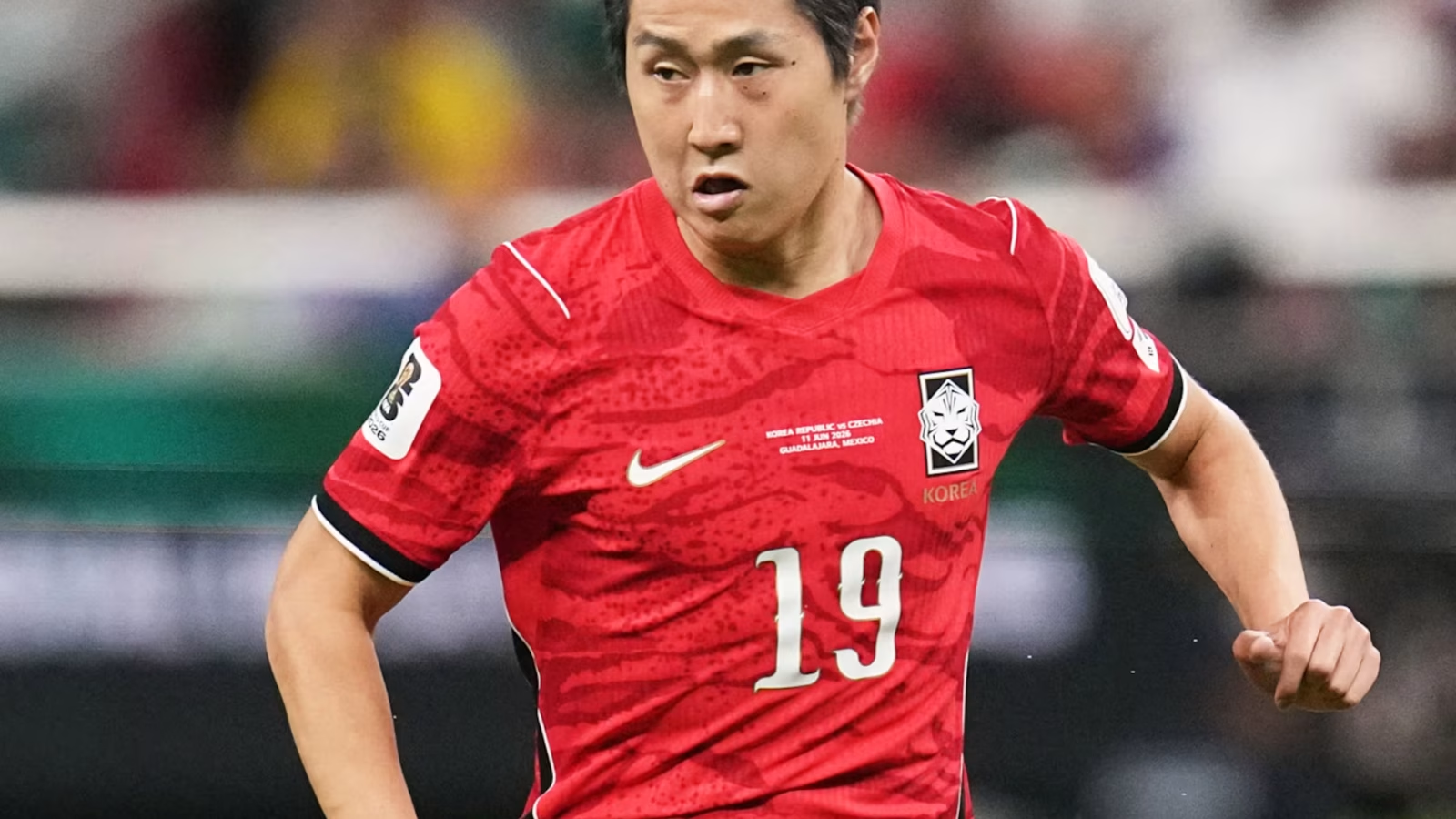
The confirmed 2026 World Cup picture surrounding Lee Kang-in is narrower than the wider speculation attached to his name, but it remains significant. What is established is that Lee Kang-in featured in the tournament context as a South Korea international, with his country placed in Group A before being eliminated in the group stage. What is not established is any claim that Atletico Madrid signed him from Paris Saint-Germain, because the verified material available here does not support such a transfer. That distinction matters, because tournament narratives can quickly become entangled with transfer noise, and in this case the firm ground is South Korea’s World Cup campaign rather than any move involving his club future.
- Lee Kang-in is verified as a South Korea international in the 2026 World Cup context.
- South Korea were listed in Group A at the 2026 tournament.
- South Korea were later eliminated in the group stage.
- No verified material here confirms a transfer involving Atletico Madrid, Paris Saint-Germain, or Lee Kang-in’s club future.
- The transfer claim therefore remains unverified and cannot be treated as established fact.
What is confirmed from the 2026 World Cup record
The clearest line in this story is the tournament record itself. Lee Kang-in forms part of the verified South Korea setup in the 2026 World Cup context, placing him on one of football’s biggest stages regardless of the uncertainty surrounding his club situation. South Korea’s place in Group A gives the campaign a clear competitive framework, while their eventual elimination in the group stage provides the defining sporting outcome. Even without further match-by-match detail in the verified material, that result alone frames the campaign as one that ended earlier than South Korea would have wanted.
For South Korea, a group-stage exit inevitably shapes how the tournament is judged. At a World Cup, the opening phase is where momentum, identity and belief either build toward the knockout rounds or fade under pressure, and South Korea finished on the wrong side of that line. Because the verified information does not include scores, scorers or specific turning points, it would be inappropriate to fill those gaps with assumption. Even so, the confirmed outcome is enough to state that South Korea were unable to turn their Group A campaign into progression, leaving the tournament before the knockout stage began.
Lee Kang-in’s confirmed place within that World Cup setting remains notable even without deeper statistical detail. International tournaments often intensify the spotlight on technically gifted and tactically flexible players, and any footballer attached to a national side at the World Cup carries that level of attention. Here, the verified record supports his relevance to South Korea’s 2026 campaign but stops short of detailing his exact on-pitch contribution. That distinction is important, because it allows the story to separate clearly what is known from what is merely circulating around him.
There is value in that discipline. In major tournaments, public discussion can quickly move beyond the available evidence, especially when a player already carries a high profile. Lee Kang-in’s name naturally draws attention, but the confirmed 2026 World Cup record remains limited to a few key points: he was part of South Korea’s tournament context, South Korea were in Group A, and the team did not progress beyond the group stage. Those facts are substantial on their own, and they should remain at the centre of any accurate account of his tournament involvement.
Why the transfer claim cannot be advanced
The other side of this story is defined not by confirmation, but by the absence of it. The verified material available here does not support the claim that Atletico Madrid signed Lee Kang-in from Paris Saint-Germain, nor does it establish any broader development regarding his club future. As a result, there is no basis to present a transfer as completed, agreed, advanced or even likely. On responsible reporting standards, the only accurate conclusion is that the transfer claim remains unverified.
That restraint matters even more during or around a World Cup, when player visibility rises and transfer speculation often accelerates with it. A footballer involved in the tournament can quickly become the subject of claims that travel faster than the evidence behind them. Lee Kang-in’s case is a reminder that a prominent international profile does not automatically validate every club rumour attached to his name. The confirmed story is his place in South Korea’s 2026 World Cup environment and the team’s group-stage exit. The unconfirmed story is any supposed move involving Atletico Madrid and Paris Saint-Germain.
There is a broader reporting principle at work as well. Club transfers and international performances often influence public conversation at the same time, but they are not interchangeable forms of proof. A player can be central to debate during a major tournament without there being any verified movement in the market. By keeping a firm line between the documented World Cup facts and the unsupported transfer claim, the picture becomes much clearer: on the evidence available here, Lee Kang-in’s 2026 narrative is international rather than transactional.
From South Korea’s perspective, that leaves the football outcome as the central point of reflection. Group-stage elimination closes the door on any deeper World Cup run and shifts attention toward assessment, rebuilding and planning for the next cycle. For a national team, that generally means evaluating what worked, what failed and how the squad can respond in the future, even if the verified material here does not provide tactical specifics. For Lee Kang-in individually, the confirmed takeaway is that he remains part of the tournament record through South Korea’s campaign, while any discussion of his next club step must wait for firmer evidence.
What follows is straightforward from a reporting standpoint. Until verified information establishes a concrete development, no transfer involving Atletico Madrid, Paris Saint-Germain and Lee Kang-in can be presented as fact. The confirmed 2026 World Cup record remains that Lee Kang-in was part of South Korea’s tournament context, South Korea competed in Group A, and their campaign ended in the group stage. If a future update emerges on his club situation, it will need to stand on its own verified footing. For now, the only solid conclusion is that the transfer claim is unverified, while South Korea’s World Cup exit remains the defining confirmed outcome.

Leave a Reply