

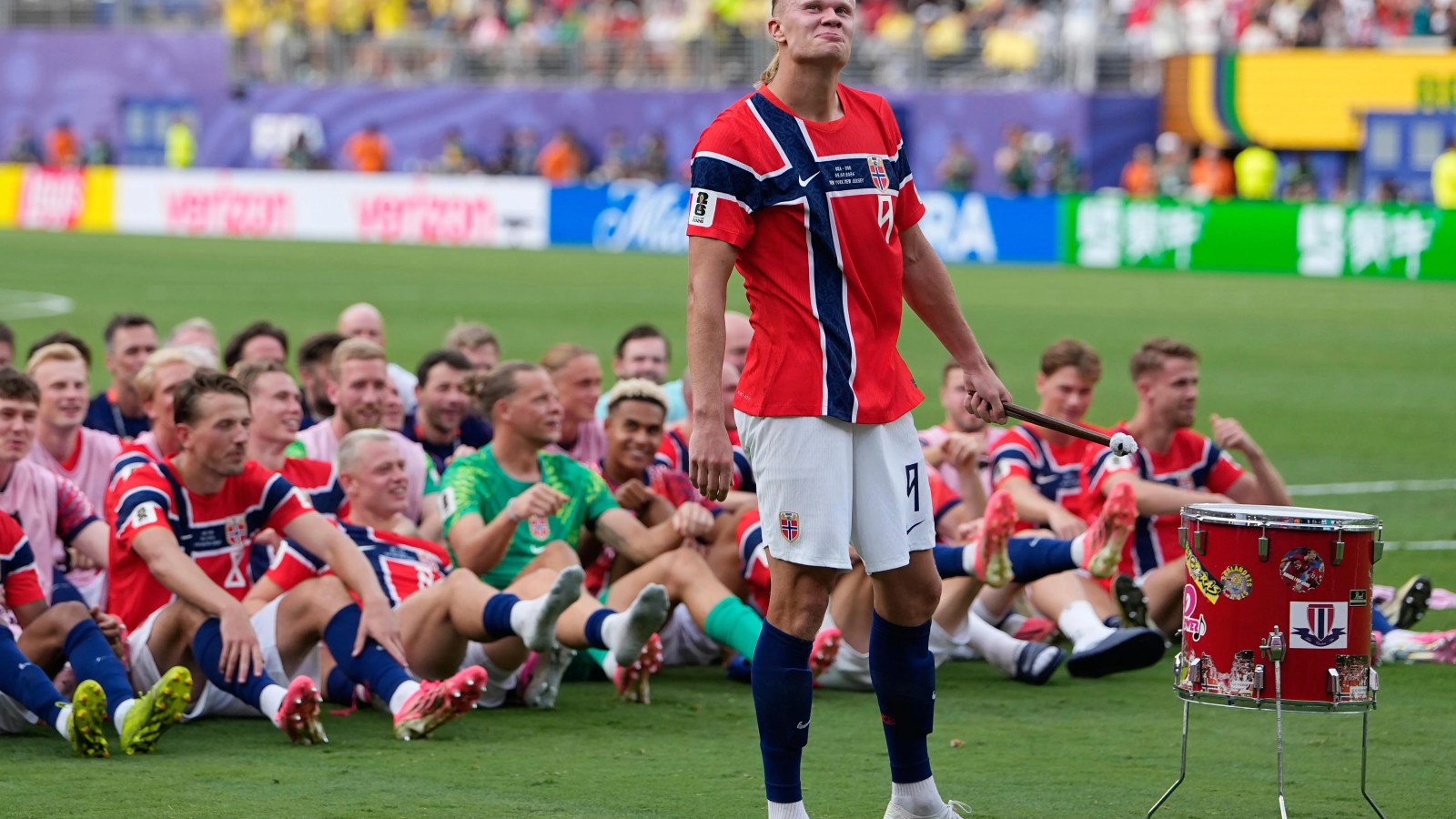
Erling Haaland has placed the spotlight squarely on England ahead of Norway’s World Cup meeting with them, insisting the burden should rest with their opponents rather than his own side. Speaking before Saturday’s quarter-final, Haaland said to “put every single pressure on the English lads,” framing the contest as one Norway can approach with freedom while England carry the greater expectations. The Norway striker also urged perspective with the reminder that “everyone should stay humble,” even as he acknowledged England should still feel confident about progressing. Those remarks immediately sharpened the mood around a knockout tie that now carries not only the usual stakes of a World Cup quarter-final, but also a clear psychological challenge from Norway’s biggest star.
- Erling Haaland said the pressure before Norway’s World Cup tie with England should be on England, telling reporters to “put every single pressure on the English lads.”
- Haaland also said “everyone should stay humble” as attention builds before the knockout meeting.
- The match is verified as a World Cup quarter-final and is scheduled for Saturday.
- Haaland added that England should still be confident of progressing despite his attempt to shift the pressure onto them.
- The verified details confirm Haaland was speaking ahead of facing England, while no further claims beyond those remarks are established here.
Haaland sets the tone before a high-stakes knockout test
Haaland’s comments matter because they do more than fill the pre-match news cycle; they establish the emotional and competitive frame for the game itself. In knockout football, especially at a World Cup, the contest over expectation can become almost as important as the tactical battle on the pitch. By saying the pressure belongs with England, Haaland is trying to define Norway as the side that can play with freedom, ambition and less external burden. That is a familiar underdog strategy, but it carries added weight when delivered by a player of Haaland’s stature. His words naturally command attention and can influence how the occasion is viewed by supporters and opponents alike.
His call for humility adds another layer. “Everyone should stay humble” works both as a warning and as a balancing statement, preventing Norway’s confidence from tipping into overstatement while also cautioning against any sense that England’s path should be straightforward. It reflects an understanding that quarter-finals are often shaped by fine margins rather than reputations alone. Even while pushing pressure toward England, Haaland did not suggest Norway had already changed the balance of power. Instead, he paired his challenge with the concession that England should still be confident of going through. That combination makes his message more pointed, because it is not reckless bravado but a calculated attempt to place England under the microscope.
There is also significance in the timing. In the days before a knockout match, every public remark can contribute to the atmosphere around it, and Haaland has ensured this tie will be discussed through the lens of expectation as much as form or quality. Norway now enter the quarter-final with a clear rhetorical position: they are dangerous, ambitious and capable, but they are not the side carrying the heaviest weight. England, by contrast, are being cast as the team that must justify the confidence surrounding them. That framing may not decide the result, but it can shape the emotional temperature in which the match unfolds.
Why the pressure narrative could shape the quarter-final
England’s status in a match like this inevitably invites scrutiny, and Haaland’s remarks lean directly into that reality. When a team is expected to progress, every phase of the match can feel heavier. A slow opening, a missed chance or a tense scoreline deep into the game can all amplify nerves. Norway, by contrast, can use that dynamic to remain mentally and emotionally composed, knowing that the longer the contest stays alive, the more the pressure can intensify on the other side. Haaland’s intervention is therefore more than a soundbite; it is a deliberate attempt to influence the psychological conditions in which the quarter-final will be played.
From Norway’s perspective, that approach makes clear sense because knockout matches often reward clarity of role. If Norway can enter the tie convinced that England are the side with more to lose, then every defensive stand, every transition and every spell of patience can feel like part of a coherent plan. Haaland’s words help build that mindset before a ball is kicked. They also underline that Norway are not approaching the quarter-final simply to take part; they are looking to compete in a way that makes England uncomfortable. Even without further detail on the likely tactical setup, the pre-match messaging points toward a Norway side eager to turn expectation into a weapon.
For England, Haaland’s comments present a familiar but still significant challenge. The demand to be confident of progressing can be read in two ways: as a compliment to their standing, and as a reminder that anything less than advancement would be judged harshly. That is the essence of pressure in tournament football. England must manage not only Norway’s threat but also the emotional discipline required when an opponent openly frames them as the team carrying the burden. The best response is usually composure rather than reaction, because allowing the narrative to dominate can play directly into the hands of the side trying to unsettle the favourite.
What stands out most is the balance in Haaland’s message. He did not dismiss England’s quality, nor did he attempt to portray Norway as obvious favourites. Instead, he identified the asymmetry of expectation and pushed it into public view, while still recognising that England have every reason to believe they can win. That gives the quarter-final an edge that goes beyond routine pre-match confidence. It becomes a contest between a team challenged to justify belief and a team encouraged to exploit the strain that belief can bring. In World Cup knockout football, that is often the space where matches are decided.
There is a reason such narratives endure in tournament play. Pressure does not guarantee mistakes, but it can alter decision-making, rhythm and confidence in subtle ways. A side expected to win may begin to force moments rather than trust them to arrive naturally, while the team cast as the outsider can draw energy from every minute it remains level or competitive. Haaland’s remarks tap into that dynamic with precision. He has not tried to overstate Norway’s position; he has simply made the emotional stakes more explicit. That alone gives his comments added relevance as the quarter-final approaches.
Saturday’s quarter-final now arrives with Haaland at the centre of the build-up, having delivered a message that is both provocative and measured. Norway will hope his words help free them to attack the occasion with discipline and conviction, while England must show that expectation is something they can carry rather than something that weighs them down. Haaland has already ensured the pressure theme will hover over the game from the first whistle. The next step is whether Norway can translate that pre-match challenge into a performance strong enough to test England’s confidence on the biggest stage.


Leave a Reply