

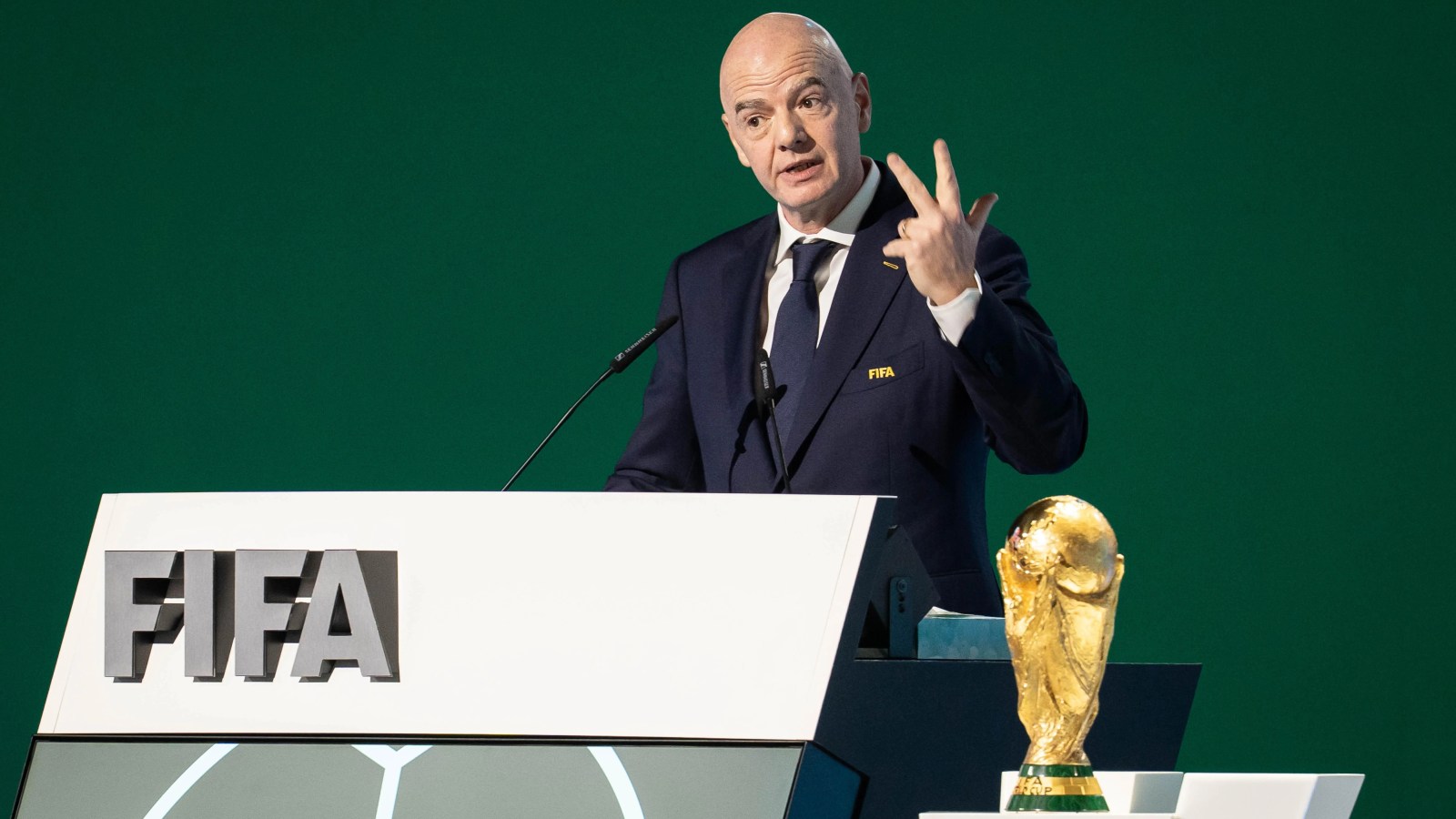
Gianni Infantino’s unusually prominent presence at the 2026 World Cup has become a storyline running alongside the football itself, with the FIFA president appearing repeatedly at matches in different host cities and prompting renewed debate over the optics of his tournament schedule. His visibility has stood out because it has extended beyond ceremonial appearances and marquee knockout fixtures. Instead, attention has centered on how often he is seen in stadiums and on broadcasts throughout the competition. That level of exposure matters because the World Cup is meant to showcase the players, teams and host venues, yet discussion has increasingly shifted toward the governing body’s most senior figure. The scrutiny has only intensified as questions have grown over the logistics of such a demanding itinerary and what it says about the image FIFA wants to project during its biggest event.
- Gianni Infantino has been a frequent on-screen presence during the 2026 World Cup and has attended multiple matches across different host cities.
- His travel schedule has drawn criticism, particularly because of references to heavy use of private-jet travel.
- Attention has also focused on an apparent plan for Infantino to attend as many as two games per day during the tournament.
- Scrutiny around his visibility combines two issues: how often he appears during matchdays and the optics of moving so aggressively around the tournament.
- One verified detail from the previous World Cup cycle states that television crews at the 2022 tournament in Qatar were ordered to show Infantino at least once during games.
A tournament-side story that refuses to fade
The modern World Cup always generates narratives beyond the pitch, and this one has settled on the visibility of the FIFA president himself. Infantino’s attendance at multiple matches across different cities has made him one of the most recognisable non-playing figures of the tournament, which is unusual even at an event built on pageantry and executive ceremony. Senior football officials are expected to appear at high-profile games, but the reaction here has been shaped by the sheer frequency of those appearances. Rather than operating as a background presence at opening events or diplomatic functions, he has become part of the daily conversation surrounding the competition.
That matters because football tournaments are carefully staged spectacles in which every image carries meaning. When a governing body president is repeatedly visible, it can create the impression that the administration of the event is competing for attention with the event itself. For some, that may suggest strong leadership and hands-on engagement across a sprawling tri-nation tournament. For others, it raises a more uncomfortable question: whether the focus is drifting away from the teams, supporters and host cities that are supposed to define the World Cup experience. The debate is not about one appearance or one camera shot in isolation, but about the cumulative effect of seeing the same official so often.
That cumulative effect has helped turn a routine matter of executive attendance into a broader discussion about presentation and priorities. The World Cup is football’s grandest stage, and the expectation is that the central figures will be the players and the supporters who give the tournament its identity. When attention repeatedly returns to the president of FIFA, it inevitably alters the tone of the wider conversation. Even those who view his travel and attendance as part of the job can still recognise why the frequency of his appearances has become a talking point in its own right.
Travel, optics and the wider FIFA image
The criticism attached to Infantino’s schedule has focused heavily on travel. References to extensive private-jet use have sharpened the response because they touch on more than convenience; they go directly to the public image of the tournament’s leadership. A World Cup spread across vast distances inevitably demands complex movement from teams, media, staff and officials, and the 2026 edition magnifies that challenge because of the scale of the host footprint. Against that backdrop, an apparent plan to attend as many as two games per day has become a symbol of both ambition and excess, depending on the perspective taken.
There is also a practical dimension to the scrutiny. Attending multiple matches in different cities on the same day is not simply a scheduling feat; it becomes a statement about access, privilege and the resources available to those at the top of the game. Supporters and participating nations are experiencing the tournament through long travel days, logistical compromises and the ordinary constraints that come with movement during a major event. That is why the optics matter so much. The issue is not only whether such a schedule is possible, but what message it sends when the president of world football appears able to move through the competition at a pace that few others could realistically match.
Another layer to the discussion comes from a verified detail connected to the previous World Cup cycle. Television crews at the 2022 tournament in Qatar were ordered to show Infantino at least once during games, a fact that now inevitably shapes how viewers interpret his recurring appearances during the 2026 event. That does not directly prove that current broadcasts are being handled in the same way, and it would go too far to claim that cameras always cut to him on that basis alone. Still, the earlier directive provides important context for why his present visibility is being examined so closely. In a tournament where every production choice is dissected, past broadcasting practice naturally informs current suspicion.
For FIFA, this is a delicate balancing act. On one hand, the president’s presence across multiple venues can be framed as an effort to represent the governing body in all corners of a geographically vast World Cup. On the other, the criticism shows how quickly visibility can become overexposure, especially when paired with concerns about private air travel and executive privilege. The governing body wants the tournament to project scale, unity and celebration across its host cities. Yet the more attention settles on Infantino’s movements, the more the conversation risks becoming about administration, image management and symbolism rather than football.
There is broader significance here for the tournament as a whole. The 2026 World Cup is already a landmark edition because of its size, its host geography and the challenge of connecting so many venues into one coherent event. In that environment, every prominent figure becomes part of the storytelling, whether intentionally or not. Infantino’s matchday presence has therefore become a lens through which people are judging the tone of the competition: who it is for, who occupies the spotlight and how power presents itself at football’s biggest showpiece. Even without definitive proof behind every claim circulating around broadcasts, the scrutiny is real because the underlying facts of his visibility and travel are already enough to sustain it.
What comes next is less about any single camera angle and more about whether this remains a persistent subplot through the rest of the tournament. If Infantino continues appearing at multiple matches across different cities, the conversation around travel, optics and prominence is likely to continue alongside the football. If his profile becomes less conspicuous, attention may naturally return more fully to the action on the pitch. Either way, this has already become one of the defining off-field talking points of the 2026 World Cup, underlining how leadership visibility can shape the atmosphere of a tournament almost as much as the games themselves.
Leave a Reply