
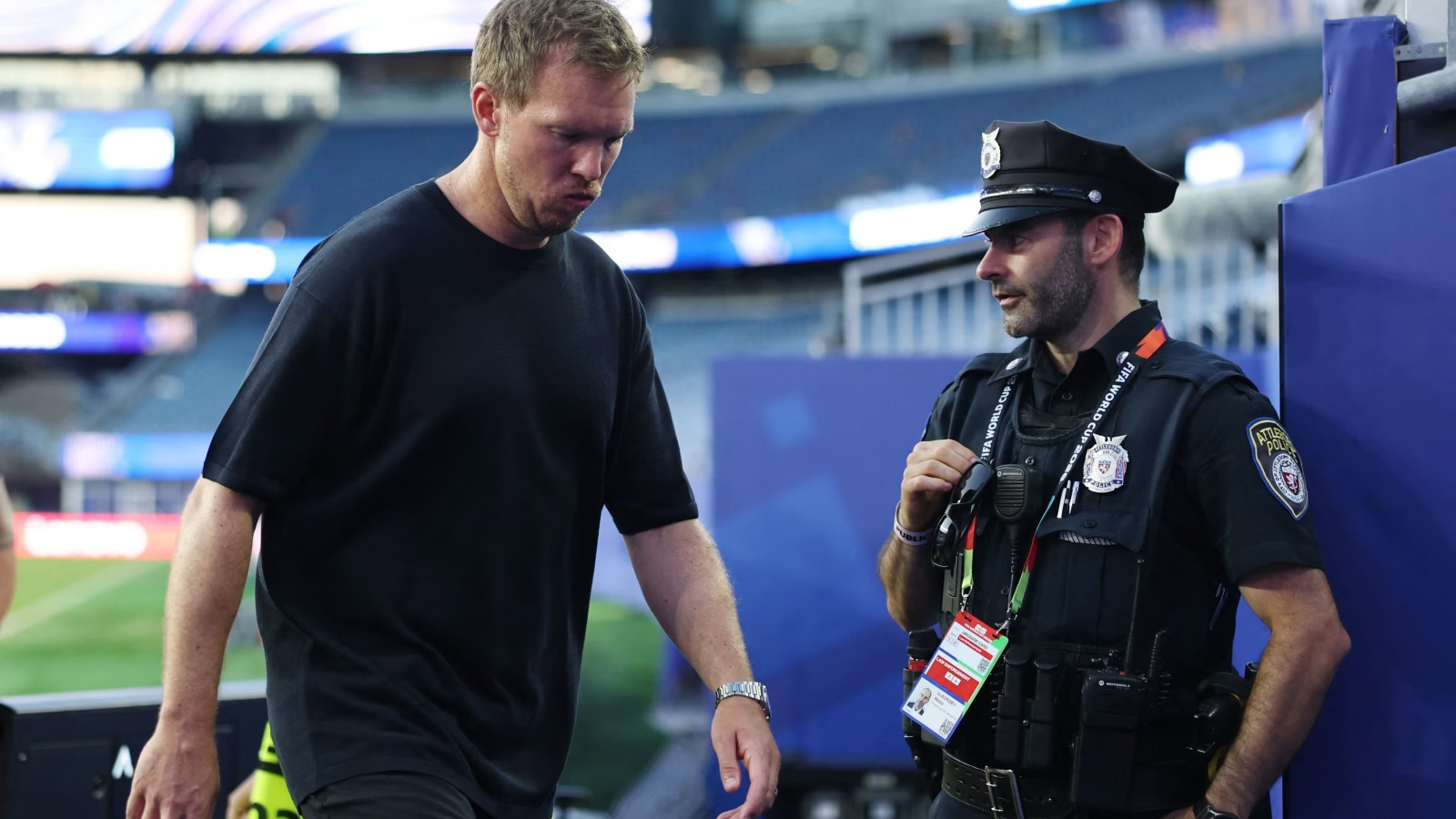
Germany’s exit from the 2026 World Cup has placed Julian Nagelsmann under intense scrutiny, leaving the national team facing a defining decision over the direction of the program after a penalty defeat to Paraguay in the round of 32. The immediate fallout has focused on whether the German federation will stay the course with Nagelsmann or turn to a new figure to lead the rebuild. Jürgen Klopp has quickly emerged as the most prominent name in that discussion, with growing attention on him as Germany’s leading candidate if a change is made. At the same time, the picture is not one-sided, with senior voices inside the squad making clear that responsibility for the disappointing campaign does not rest solely with the coach.
- Germany exited the World Cup after a penalty defeat to Paraguay in the round of 32.
- Julian Nagelsmann’s future as national team coach is under pressure following the elimination.
- A decision on Nagelsmann’s future could come within days.
- Jürgen Klopp is being discussed as Germany’s leading or preferred candidate if a coaching change is made.
- Joshua Kimmich has backed Nagelsmann to remain in charge and said the players share responsibility for the campaign.
- Klopp has said he has not considered the Germany role and remains focused on his current job.
Pressure mounts after knockout disappointment
For Germany, the significance of this exit extends well beyond a single result. A round-of-32 elimination is a major setback for a nation that measures itself against the latter stages of the World Cup, and the manner of the defeat has only sharpened the frustration. Penalty shootouts can reduce the margin between success and failure, but they rarely soften the judgment that follows an earlier-than-expected tournament exit. In Germany’s case, the conversation has quickly shifted from the match itself to the broader health of the national-team project and whether the current coaching setup remains the right one.
Nagelsmann now stands at the center of that debate. Tournament football often compresses opinion into a handful of decisive moments, and a coach’s standing can change dramatically once elimination arrives. Everything around Germany suggests his future is under genuine pressure, with a verdict potentially arriving within days rather than weeks. That timetable underlines the urgency of the moment, because Germany are not only assessing one failed campaign but also deciding how quickly they need to reset before the next phase of international competition begins.
Even so, the case against Nagelsmann is far from absolute. Kimmich’s support matters because it indicates a dressing room that does not appear to be turning against the coach. His view that the players themselves must accept responsibility is especially significant in the aftermath of a tournament exit, when blame can easily be directed upward. That intervention changes the tone of the discussion. Instead of a simple argument that the coach failed, it becomes a more complex assessment of collective underperformance, execution under pressure, and whether changing the manager would truly address the underlying issues.
That distinction is important for any federation trying to separate emotion from strategy. Germany’s elimination was damaging in both symbolic and competitive terms, but the response cannot be based solely on the shock of the result. The central question is whether this campaign exposed a terminal flaw in Nagelsmann’s leadership or whether it revealed shortcomings that extend beyond the touchline. If the latter view carries weight internally, then continuity may still be seen as a credible path, even after such a disappointing finish.
There is also the reality that knockout football can magnify every weakness. A team that never fully establishes control over a tournament leaves itself vulnerable to exactly the kind of fine-margin exit Germany suffered. That does not automatically absolve the coach, but it does reinforce the idea that this was not simply one bad night. The federation’s review is likely to focus on whether Germany looked coherent enough, resilient enough and decisive enough across the campaign to justify staying with the current staff.
Klopp’s name adds weight to the decision
The emergence of Klopp as the leading name in the background only increases the stakes. Germany are not merely considering whether Nagelsmann deserves more time; they are also confronting the possibility of a high-profile alternative whose stature naturally reshapes expectations. When a figure of Klopp’s standing enters the conversation, even indirectly, the debate becomes less about patience and more about opportunity. If decision-makers believe an elite replacement could be available, the threshold for keeping the incumbent becomes much harder to clear.
At the same time, Klopp’s own position introduces an important note of restraint. He has said he has not considered the Germany role and remains focused on his current job, meaning the speculation around him is not the same as a confirmed opening or an active pursuit nearing completion. That matters because it prevents the situation from becoming a straightforward succession story. Germany may admire Klopp and view him as a preferred option, but admiration alone does not guarantee availability, and any decision on Nagelsmann has to be made with that uncertainty in mind.
That uncertainty could prove decisive in the federation’s internal thinking. If Germany move on from Nagelsmann, they would want clarity not only on who comes next but also on whether that appointment can be made quickly and convincingly. A change without a secure successor can deepen instability rather than solve it, especially after a disappointing World Cup. By contrast, retaining Nagelsmann would allow Germany to argue that the campaign’s failings were shared by the squad and that continuity, combined with a hard review of what went wrong, offers a better route back than another abrupt reset.
There is also a wider football question beneath the personnel debate. Germany’s elimination has revived familiar concerns about translating talent and preparation into knockout-stage success, particularly when matches tighten and margins become unforgiving. A penalty defeat can be framed as cruel misfortune, but it can also be seen as the final expression of a campaign that never established enough authority to avoid such a precarious ending. That is why the next decision will be judged not only as an emotional reaction to the exit, but as a measure of whether the federation believes the current staff can build a side that looks more resilient, more coherent and more decisive when the next major test arrives.
From Nagelsmann’s perspective, Kimmich’s backing offers a meaningful, if not definitive, argument in his favor. Support from a senior player can help preserve a coach when results turn, particularly if the dressing room still believes in the methods and accepts its share of the blame. But support alone may not be enough if the federation concludes that this World Cup represented a ceiling rather than a setback. The coming days therefore appear likely to hinge on one central question: was Germany’s exit the product of a campaign that still contains the foundations for progress, or evidence that a more dramatic change is now required?
What happens next is likely to unfold quickly. Germany must decide whether to keep faith with Nagelsmann and frame this World Cup as a painful but recoverable disappointment, or respond to the pressure created by the exit by opening the door to a new era. Klopp’s status as the standout alternative ensures that any review will carry added intrigue, even with his focus remaining on his current role. For now, Germany are left balancing accountability, continuity and ambition as they search for the right response to one of the tournament’s most consequential eliminations.


Leave a Reply