


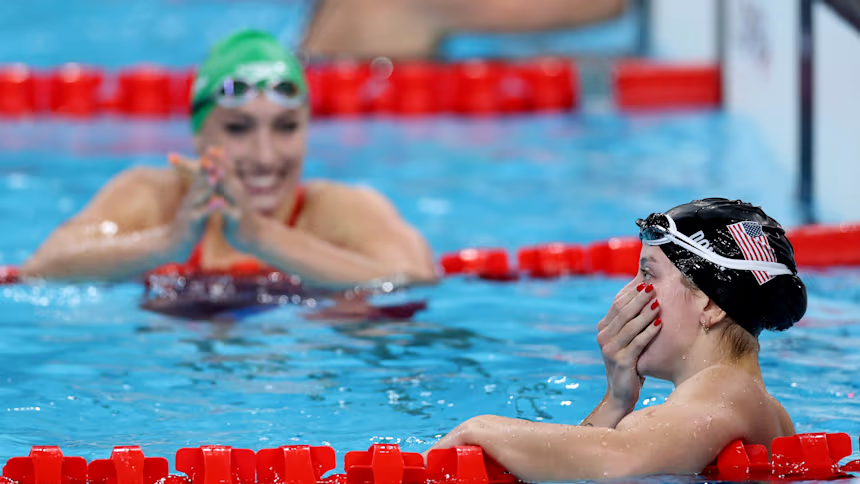
Kate Douglass, a USA swimmer and statistics major, implemented a race strategy in the women’s 200m breaststroke final on August 1 that earned her an Olympic gold medal. Her plan? Stick to the plan, stay calm, and count strokes. Although her strategy might not earn high marks from her university professors for execution, Douglass achieved something even better – an Olympic gold medal at Paris 2024.
“To get an individual Olympic gold is such an amazing feeling and to already have two medals from this meet, that’s more than I ever could have imagined,” said Douglass, who also helped Team USA to a silver medal in the 4x100m freestyle relay earlier in the week.
From Classroom to Olympic Pool: Kate Douglass Applies Statistics to Sport
Douglass, a two-time Olympian, completed her bachelor’s degree in statistics in 2023 and is now pursuing a master’s degree in the same field at the University of Virginia. It was during her studies that she realized how statistics could improve her swimming.
“I got to UVA and I started to see it used more in swimming. I didn’t realize that beforehand, but now it’s definitely a big part of swimming,” Douglass explained. By applying her knowledge of data analytics, Douglass has been able to refine her technique and shave crucial tenths of a second off her times.
Douglass co-authored an academic paper titled “Swimming in Data,” under the guidance of mathematics and data science professor Ken Ono. The paper examines the use of mathematical formulas and Newton’s Laws of Motion in analyzing the efficiency of swimmers’ strokes. This research, which included using accelerometers and sensor bands to measure acceleration rates, has directly influenced Douglass’ training and performance.
“There’s a lot that goes into it and different techniques and different devices that we can use to see certain acceleration at points in the stroke and figure out how to maximize that,” said Douglass. Despite utilizing modern technology, Douglass also relies on a simple, low-tech method: counting her strokes.
The Strokes and Stats Behind Douglass’ Races at Paris 2024
Counting strokes has become an integral part of Douglass’ race strategy, helping her maintain consistency and efficiency in the pool. This method was crucial during the 200m breaststroke final at Paris La Defense Arena, where she competed against reigning world champion Tes Schouten of the Netherlands and defending Olympic champion Tatjana Schoenmaker from South Africa.
Smith took an early lead, but Douglass surged ahead in the second lap and maintained her position until the finish, touching the wall at 2:19.24. Douglass’ time improved upon her own American record of 2:19.30, while Smith finished second at 2:19.60, and Schouten secured third with a time of 2:21.05.
“I feel like for the past few times, at least, that I’ve gone a 2:19, I’ve had a specific stroke count that I’ve stuck to and so I knew going into that race, if I stuck to that plan, I’d be able to go 2:19 again,” Douglass remarked.
Smith praised Douglass after the race, stating, “She pushed me to be a better version of myself and I couldn’t have asked for anything more.”
The moment was surreal for Douglass, who, overwhelmed with joy, couldn’t believe she had won gold. “A few months ago, if you told me that I would win a gold medal at the Olympics, I wouldn’t believe you,” she said. “It’s just a surreal moment.”
Douglass’ blend of academic prowess and athletic dedication exemplifies the intersection of education and sport, demonstrating how intellectual discipline can lead to Olympic success.



Leave a Reply