

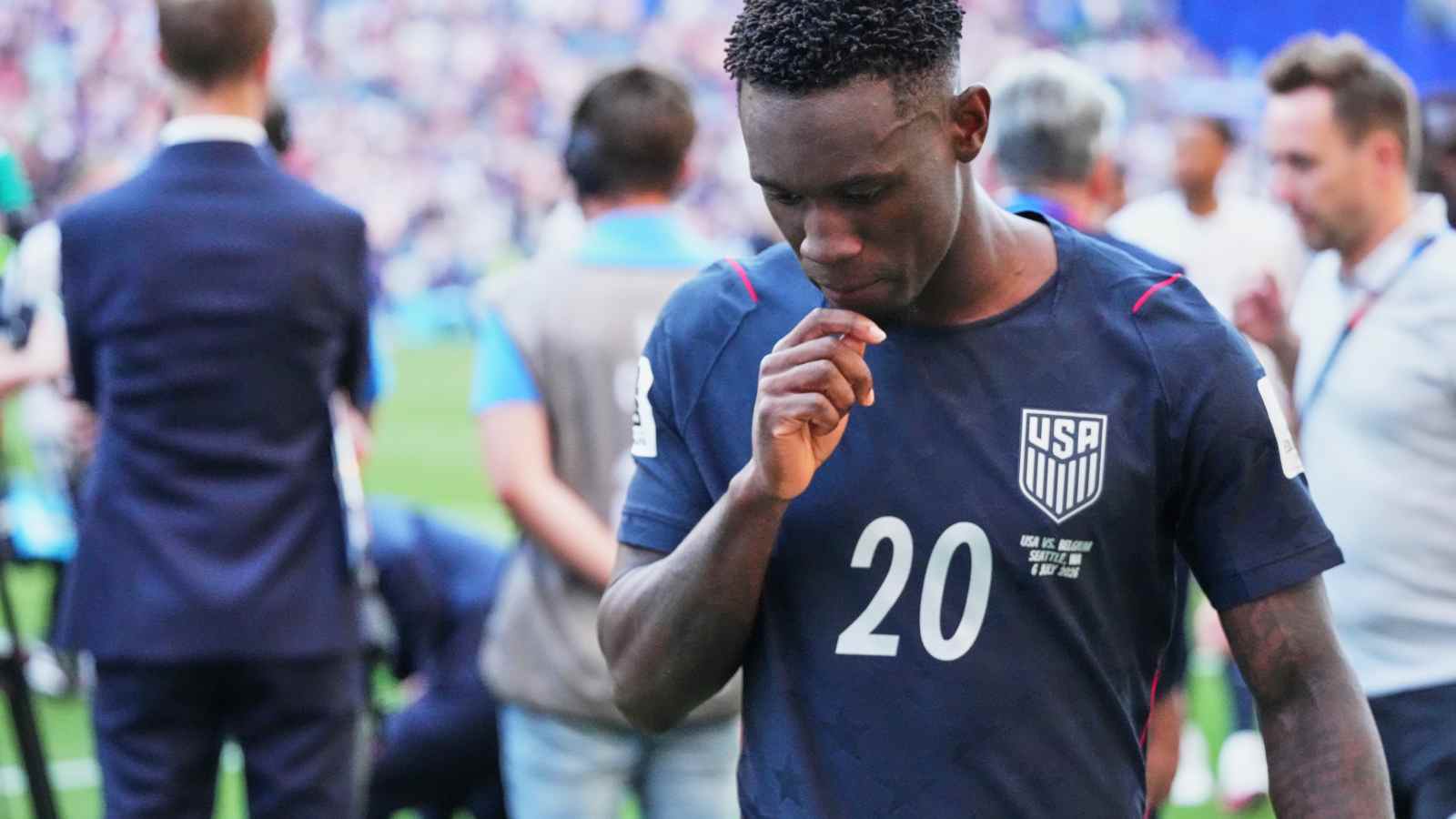
Folarin Balogun’s return to availability for the United States has become one of the defining off-field stories of the 2026 World Cup, with the striker acknowledging that he knew President Donald Trump’s intervention over his suspension would trigger controversy. The decision carried immediate significance because it restored a key attacking option before the Americans’ last-16 meeting with Belgium, altering the complexion of a knockout tie at the most delicate stage of the tournament. It also resonated more broadly, placing the boundaries between football governance and political influence under intense scrutiny. Balogun sits at the center of the episode not only because the original red card removed him from the picture, but because the reversal turned his availability into a national talking point as much as a sporting one.
- Folarin Balogun said he knew President Donald Trump’s intervention over his World Cup suspension would cause controversy.
- Trump personally intervened after Balogun’s red card, and FIFA reversed the striker’s one-match ban.
- The reversal made Balogun available again for the United States ahead of the last-16 match against Belgium.
- The intervention changed the dynamic before the knockout meeting with Belgium.
- Trump later praised the decision to overturn the suspension and described the original red-card call as “horrible.”
- Trump called FIFA president Gianni Infantino directly after the match in which Balogun was sent off.
A decision that reshaped the knockout picture
The significance of the reversal begins with its timing. In a World Cup knockout round, the loss of a starting striker can force a team to rethink not only its front line, but the balance of its entire approach. Balogun’s suspension had threatened to remove pace, direct running and a focal point from the United States attack at exactly the stage when margins narrow and matches are often decided by a single transition, one pressing trap or one penalty-box action. Once the ban was overturned, the United States regained a player capable of stretching a defense and changing how Belgium needed to prepare.
That is why the political dimension cannot be separated from the footballing one. Trump’s direct involvement, including a call to FIFA president Gianni Infantino after the match in which Balogun was sent off, elevated what might otherwise have remained a disciplinary matter into a global controversy. Balogun’s own acknowledgment that he expected that reaction adds another layer to the episode, suggesting there was already an awareness inside the camp that the story would not simply fade once the ban was lifted. Instead, the decision became part of the buildup to the Belgium match, shaping debate around fairness, influence and whether a World Cup should ever be touched by this level of outside pressure.
From the United States perspective, the practical impact is clear even without moving beyond the established facts. A team preparing for Belgium with Balogun available is preparing for a different game than one without him. Coaches can preserve continuity in attack rather than redesigning the structure around an enforced absence, while teammates can maintain familiar patterns in buildup and final-third movement. Belgium, in turn, had to account once again for Balogun’s presence, and that alone is enough to support the view that the intervention changed the dynamic before the last-16 contest.
In that sense, the reversal did more than restore one player to the team sheet. It shifted the emotional and tactical landscape surrounding the tie. The United States moved from contingency planning back to a more natural attacking setup, while Belgium lost the certainty that comes with facing an opponent deprived of one of its principal threats. At this stage of a World Cup, even small changes in personnel can carry outsized consequences, and Balogun’s reinstatement was not a minor adjustment. It altered the questions both sides had to answer before kickoff.
Controversy, precedent and pressure on all sides
The controversy also cuts in several directions at once. For Balogun, being restored to the squad is clearly beneficial on a sporting level, but it also places him under a more intense spotlight than any player would want before a major knockout match. Every touch, run and chance against Belgium was bound to be viewed through the prism of how he became available again. Instead of discussing only his form or his fit within the American attack, the narrative expanded to include presidential intervention, FIFA’s response and the legitimacy of the process that led to the ban being overturned.
For FIFA, the episode raises uncomfortable questions even when confined strictly to the established facts. The governing body reversed the one-match ban after Trump’s intervention, and that sequence inevitably invites debate about consistency and independence. Disciplinary decisions at a World Cup are supposed to carry authority because of the tournament’s scale and the need for clear standards. When a suspension is overturned in circumstances this politically charged, the outcome is not only relief for one team but also a wider conversation about precedent, perception and whether all teams can feel they are operating under the same framework.
Trump’s own comments ensured the issue would remain active rather than recede into the background. By praising the reversal and calling the original red-card decision “horrible,” he reinforced the sense that this was not a quiet administrative correction but a public victory in a dispute he had entered personally. That matters because it keeps attention fixed on the process as much as the player. In tournament football, outside noise can either galvanize a squad or burden it, and the United States had to navigate both the benefit of getting Balogun back and the distraction created by the manner of his return.
Belgium, meanwhile, became the immediate opponent forced to deal with the consequences of a decision made beyond the pitch. Any knockout preparation revolves around certainty: who is available, what threats must be contained and which spaces can be attacked. The reversal removed one certainty and inserted another problem for Belgium to solve. Even without adding unverified tactical specifics, it is clear that Balogun’s availability altered the planning process and increased the range of attacking possibilities open to the United States, which is precisely why this story carried such weight before the last-16 tie.
There is also a broader World Cup context to consider. Major tournaments often produce moments that outgrow the matches themselves, and this is one of them because it sits at the intersection of sport, politics and power. Balogun’s case is not just about one red card or one overturned ban; it is about how quickly a disciplinary issue can become a referendum on influence when the stakes are high enough. The United States gained an important player back for a decisive game, but the debate attached to that gain ensured the story would resonate well beyond a single team sheet.
What comes next is twofold. On the field, attention turns to how the United States uses Balogun’s restored availability in the knockout phase and whether his presence proves decisive against elite opposition. Off the field, the controversy is unlikely to disappear soon, because the circumstances of the reversal have already become part of the tournament’s political history. Balogun may have anticipated the reaction, but the scale of the discussion shows just how sensitive World Cup decisions become when power enters the frame. For the United States, the immediate reward was clear: their striker was back, and the path into the last 16 looked different because of it.
Leave a Reply