

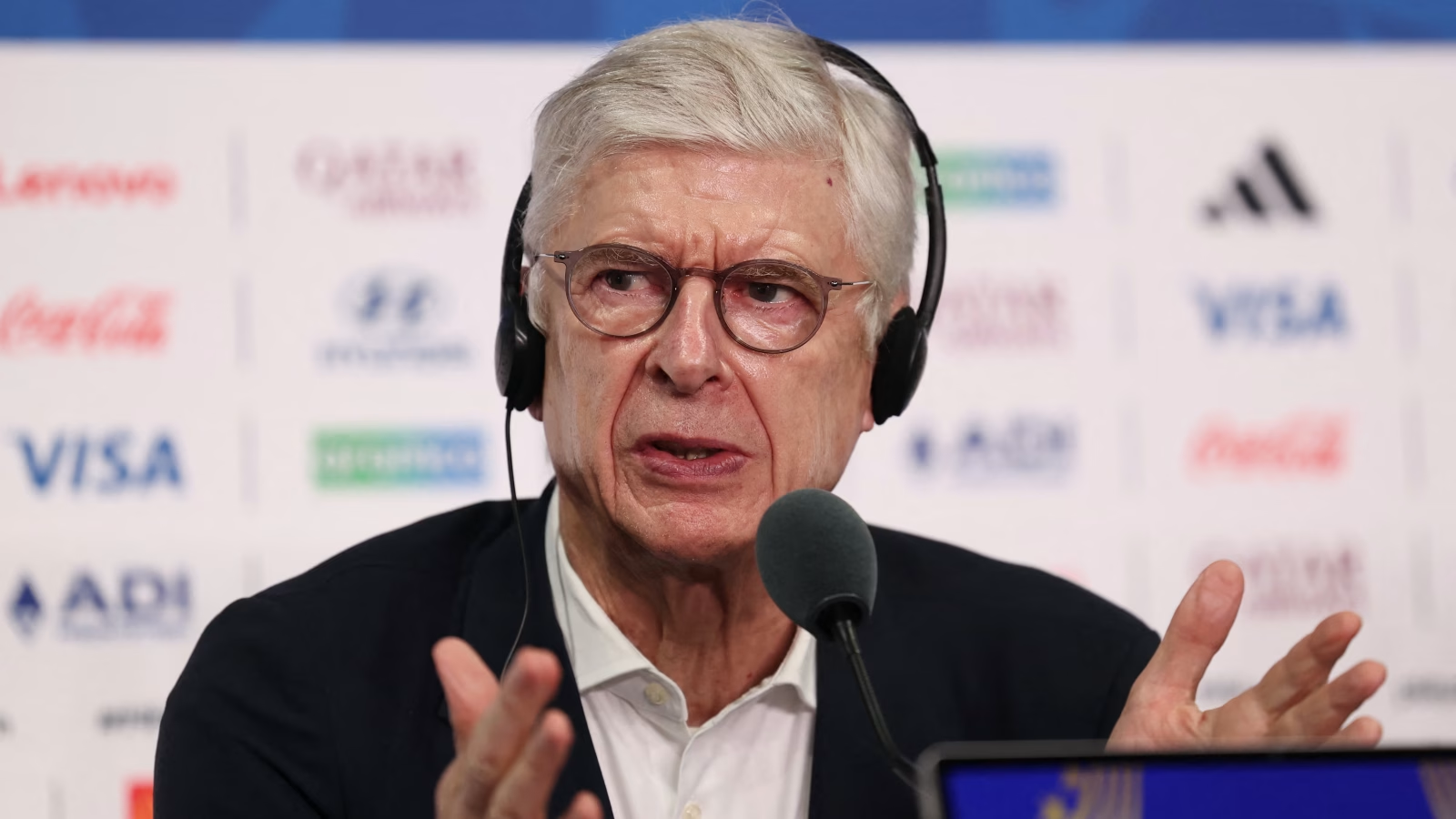
Arsene Wenger has described FIFA’s decision to abandon plans to sell stakes in the World Cup as “absolutely necessary” and “beyond question,” backing a reversal that removes one of the most contentious governance issues of the 2026 tournament cycle. Gianni Infantino confirmed on Saturday that FIFA would not proceed with the proposal, bringing to an end a debate that had escalated into a serious confrontation with major parts of world football’s leadership. The retreat matters because the World Cup is not only FIFA’s flagship competition but also the game’s central commercial and sporting asset, making any attempt to open it to private investment especially sensitive. Wenger’s support for the U-turn adds further weight to the view that FIFA had little room to continue once opposition hardened across multiple confederations and UEFA raised the prospect of a boycott.
- Arsene Wenger said FIFA’s reversal on plans to sell stakes in the World Cup was “absolutely necessary” and “beyond question.”
- Gianni Infantino confirmed on Saturday that FIFA would not proceed with the proposal.
- The plan faced strong resistance, with three continental confederations rejecting it.
- UEFA warned of a possible boycott of the World Cup and other FIFA competitions if the idea moved forward.
- UEFA said its national associations unanimously rejected opening FIFA competitions to private investors.
- Wenger has no plans to leave FIFA despite the row over the abandoned proposal.
Why the reversal became unavoidable
The scale of the backlash explains why Wenger framed the decision in such emphatic terms. Once three continental confederations had rejected the proposal, the issue was no longer a matter of internal debate or commercial fine-tuning. It had become a direct challenge to the consensus needed to protect the legitimacy of FIFA’s premier competition. UEFA then intensified that pressure by warning of a possible boycott of the World Cup and other FIFA competitions, underlining how far the dispute had progressed. In practical terms, any World Cup-related proposal that prompts open discussion of non-participation by leading stakeholders is almost impossible to sustain.
The significance of UEFA’s position went beyond rhetoric because it reflected a unanimous rejection by its national associations of the idea of opening FIFA competitions to private investors. That unanimity stands out in a political landscape that more often produces fragmented alliances and carefully hedged statements than a single collective line. When national associations align so clearly against a structural commercial proposal, the pressure on FIFA becomes immediate and difficult to contain. Wenger’s remarks therefore read not simply as support for a policy change, but as recognition that the governing body had reached a point where retreat was the only realistic option.
That is what made the reversal feel less like a strategic adjustment and more like a necessity. The World Cup occupies a unique place in football governance, and any move that appears to alter its ownership model or long-term control inevitably invites scrutiny far beyond normal commercial discussions. As resistance grew, the proposal became a test of authority and legitimacy rather than a debate over financial structure. By the time boycott warnings entered the conversation, FIFA was no longer defending a plan on its merits; it was trying to contain a dispute that threatened to damage the unity on which the tournament depends.
What it means for FIFA and the 2026 World Cup
For FIFA, abandoning the proposal helps restore a measure of stability around the World Cup at a time when planning, promotion and competitive anticipation should be the priority rather than institutional conflict. The tournament’s value lies not only in the revenue it generates but in its status as a shared global event. That standing can be weakened if key football authorities believe control is being diluted or commercialised in ways they cannot support. By stepping back, FIFA avoids allowing the issue to overshadow the build-up to 2026 and removes the immediate risk of a governance dispute spilling into the competition itself. Infantino’s confirmation on Saturday effectively closed the door on a plan that had begun to threaten the unity needed to stage the tournament under the broadest possible consensus.
Wenger’s intervention is also notable because it helps clarify that the fallout has not developed into a personal rupture between senior figures and FIFA. Separate indications that he has no plans to leave his role despite the row suggest that, while the proposal generated major opposition, the reversal has created space for continuity rather than further upheaval. That matters for FIFA because prolonged uncertainty around prominent football executives would only deepen the impression of instability. Instead, the message now is that the organisation can move on from the dispute, having accepted that the political cost of the plan far outweighed any potential strategic benefit.
There is also a broader lesson in how quickly the issue escalated from a commercial concept into a constitutional question about who ultimately shapes the future of the World Cup. The reaction from confederations and national associations showed that many stakeholders view the tournament as an asset whose stewardship must remain firmly within football’s existing structures. Even without additional financial details entering the debate here, the resistance itself revealed the sensitivity of any move that appears to alter the balance between sporting governance and outside capital. FIFA’s retreat, and Wenger’s endorsement of it, indicate that the threshold for change around the World Cup remains extremely high when federations believe core principles are at stake.
From a 2026 perspective, the decision should ease concerns that administrative conflict could intrude on the tournament’s build-up. The World Cup depends on cooperation across confederations, associations and organising structures, and that cooperation becomes harder when trust is strained by disputes over ownership, influence or long-term control. By stepping away from the proposal, FIFA reduces the likelihood that future meetings and preparations will be dominated by arguments over governance rather than football. It also allows attention to return to the competition itself, which is where stakeholders will want the focus as the next World Cup approaches.
The next phase is likely to be shaped less by the abandoned proposal itself and more by how FIFA manages relationships after such a public confrontation. Wenger’s clear endorsement of the reversal offers one sign that the organisation is trying to draw a line under the matter, while Infantino’s confirmation provides formal closure to a plan that had become politically toxic. For the World Cup, that is a significant outcome: the competition moves forward without the immediate threat of boycott talk hanging over it, and without a continuing battle over private investment in FIFA events. What comes next will test whether that reset can hold, but for now the governing body has stepped back from a dispute that had become impossible to defend and, in Wenger’s words, beyond question.

Leave a Reply