

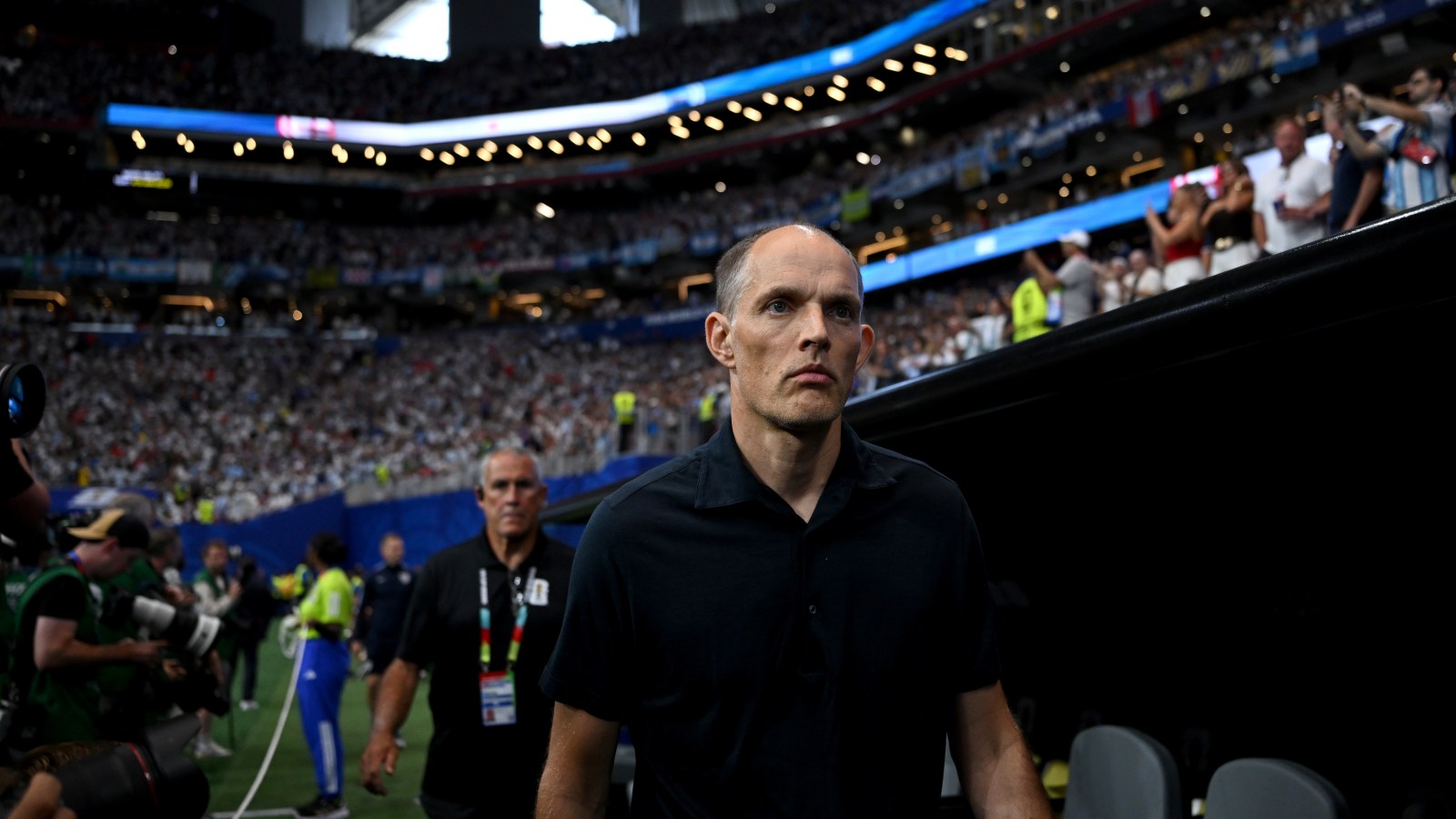
Thomas Tuchel has declared himself “100 per cent” committed to remaining as England manager through Euro 2028, insisting the national team’s World Cup semi-final defeat to Argentina will not alter his determination to continue the project. In the immediate aftermath of the loss, Tuchel defended his tactical approach and argued that the more fundamental issue lies in the “DNA” of English football rather than in a single game plan or one tournament decision. That position matters because it moves the debate beyond one result and toward the broader identity of the national side. At a moment when England are processing the disappointment of falling short in the last four, Tuchel has made clear that he sees the answer in long-term change rather than short-term reaction.
- Thomas Tuchel says he is “100 per cent” committed to staying on as England manager through the next European Championship in 2028.
- England’s World Cup campaign ended with a semi-final defeat to Argentina.
- Tuchel defended his tactical approach in the aftermath of the exit.
- He argued that the deeper issue is the “DNA” of English football.
- Tuchel believes that “DNA” must change if England are to win major tournaments.
Tuchel frames the debate beyond one defeat
Tuchel’s response to elimination is notable because it resists the familiar pattern that often follows England defeats at major tournaments. Rather than presenting the loss to Argentina as proof that the tactical plan was flawed from the outset, he has drawn a distinction between match-specific choices and the wider football culture that shapes the team. That does not remove scrutiny from the manager, but it does place his decisions within a larger argument about how England develop, play and respond under pressure on the biggest stage. By defending his tactical approach, Tuchel is effectively saying the semi-final was not simply lost on the touchline.
His use of the word “DNA” is especially significant because it points to a structural issue rather than a temporary one. In football terms, that can include mentality, technical habits, risk tolerance, game management and the collective instincts that emerge in elite matches. Tuchel’s point, as he has framed it, is that winning major tournaments requires more than organisation and talent alone; it also demands a football identity capable of holding up in decisive moments. England’s elimination by Argentina therefore becomes, in his view, part of a broader pattern that cannot be solved simply by changing formation, personnel or in-game instructions.
What Tuchel’s commitment means for England’s next cycle
By committing himself through Euro 2028, Tuchel is also offering the Football Association and the squad a measure of continuity after a painful exit. International football can be shaped by abrupt emotional swings, with one result often prompting calls for a reset, but Tuchel’s message is that progress may depend on staying the course. That matters because tournament football rarely rewards instability, and England now face the challenge of turning a semi-final appearance into a platform rather than a breaking point. His pledge removes uncertainty over his own future and shifts the emphasis to whether the team can evolve in the way he believes is necessary.
There is also practical significance to that timeline. A commitment to Euro 2028 suggests Tuchel wants enough time not only to prepare for another tournament but also to influence the habits and identity of the side across multiple international windows. If he believes England’s “DNA” must change, then he is arguing for a process that extends beyond immediate selection calls or one-off tactical tweaks. That kind of transformation is difficult in international management, where time on the training ground is limited, but it can still be pursued through clarity of message, consistency of approach and repeated exposure to high-level matches. Tuchel’s comments indicate that he sees the next cycle as an opportunity to reshape England more deeply.
For England, the challenge now is how to interpret that diagnosis constructively. A semi-final exit is painful because it confirms the team were close to the final without reaching it, and that naturally sharpens debate over what was missing. Tuchel’s answer is that the missing piece is not merely one better tactical call in one game, but a broader evolution in how English football defines itself. It is a demanding argument because it asks players, coaches and the wider environment to think beyond immediate blame and toward ingrained habits. It also raises the stakes for the next tournament cycle, because Tuchel has publicly tied his future to the belief that this deeper change is both necessary and possible.
His defence of the tactical approach should also be read in that context. Managers often face the strongest criticism after knockout defeats, especially when expectations are high, but Tuchel has chosen not to retreat from his ideas. Instead, he has doubled down on the belief that tactical plans can only go so far if the underlying football culture does not fully support tournament-winning performances. That does not mean tactics are irrelevant; rather, it means he sees them as one layer of a larger competitive identity. The implication is that England must become a side whose football instincts, not just their preparation, are capable of carrying them through the most demanding matches.
There is, then, both risk and conviction in Tuchel’s position. The risk is obvious: by staying on and by making such a clear argument about England’s “DNA,” he is taking ownership of the next phase and inviting judgment on whether his diagnosis leads to visible improvement. The conviction lies in his refusal to treat the semi-final defeat as a reason to abandon the project. He is presenting England’s setback against Argentina as evidence of a deeper need for change, while also insisting that he is the right person to oversee that change. In elite international football, that combination of accountability and long-term intent can define the direction of an entire cycle.
What comes next is a period of reflection followed by reconstruction. England must absorb the disappointment of a World Cup run that ended one step short of the final, while Tuchel must turn his argument about “DNA” into a practical roadmap for the years ahead. His commitment through Euro 2028 ensures the focus now shifts from speculation over his future to the substance of his ideas and the team’s capacity to embody them. If England are to convert another deep tournament run into a genuine title challenge, the next chapter will be shaped by whether Tuchel can translate that diagnosis into lasting change.


Leave a Reply