

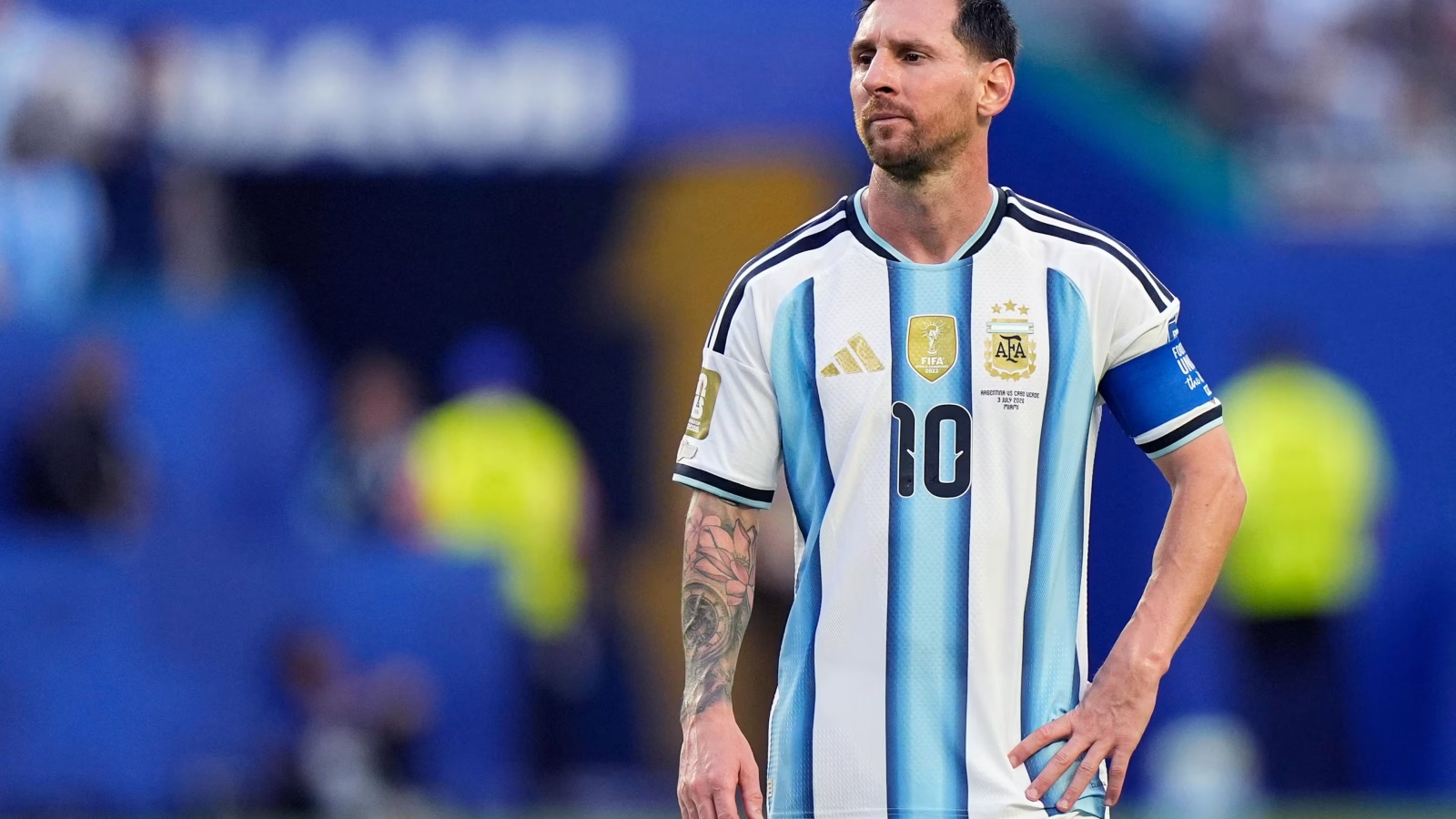
Argentina’s FIFA World Cup 2026 campaign remains alive deep into the tournament after a 3-1 extra-time quarter-final victory over Switzerland, a result that sends the South American side into the semi-finals and sets up a meeting with England on July 15. The confirmed facts around Argentina’s progress are significant enough on their own: they came through the group stage, won a demanding knockout tie that required added time, and now stand one match away from the final. With official tournament material also showing the squad in training before the semi-final, the focus has already shifted from survival to opportunity. The standout figure in this story is Argentina as a team rather than any one individual, because the verified record confirms the nation’s advancement but does not identify scorers, creators or specific star performances from the quarter-final.
- Argentina beat Switzerland 3-1 after extra time in the World Cup 2026 quarter-finals.
- The win sends Argentina into the semi-finals of the tournament.
- Argentina’s semi-final against England is scheduled for July 15, 2026.
- Official tournament material places Argentina’s group-stage schedule in Kansas City and Dallas.
- Argentina’s squad, fixtures, results and statistics are listed on official tournament team pages, underlining their active progress through the competition.
Quarter-final resilience keeps Argentina on course
The most important aspect of Argentina’s quarter-final success is the way it was achieved. A 3-1 win after extra time points to a contest that could not be settled within 90 minutes, demanding patience, discipline and endurance before Argentina eventually pulled away. In knockout football, that kind of result often reveals as much about emotional control as technical quality, because teams must absorb the pressure of a level match while still finding the conviction to force the decisive breakthrough. Argentina did exactly that, and the reward is a place among the final four.
That progression matters because the World Cup narrows quickly once the knockout rounds begin. Group-stage promise can disappear in a single difficult evening, especially against an opponent capable of extending the game and testing concentration over a longer period. Argentina’s ability to come through extra time points to a side with enough structure and competitive edge to handle a match that becomes stretched, tense and unforgiving. Even without verified details on the goals themselves, the scoreline alone shows that Argentina found another level when the game demanded it most.
There is also broader competitive significance in beating Switzerland in this fashion. Matches that go beyond regulation often become tests of squad management, physical freshness and tactical discipline, because spaces open up and mistakes carry even greater consequence. Argentina emerged from that environment with a two-goal margin, suggesting a strong finish rather than a narrow escape. For a team with ambitions of winning the tournament, that kind of knockout resilience can become a defining trait as the pressure intensifies.
Just as importantly, the result reinforces the value of collective execution. The verified record does not assign the decisive moments to any one player, so the clearest conclusion is that Argentina’s progress has been built on the group’s ability to withstand pressure and deliver when the stakes rise. In tournament football, that can be every bit as important as individual brilliance. Argentina’s quarter-final showed they could stay composed long enough to turn a difficult tie into a convincing final score.
Semi-final focus turns to England and the scale of the moment
The next step is even bigger: a semi-final against England on July 15. Reaching this stage places Argentina in the most demanding territory of any World Cup, where every detail is magnified and every decision can shape a nation’s hopes. Official training material ahead of the match confirms that preparations are already under way, and that alone captures the immediacy of the challenge. There is little time in a tournament setting to celebrate a quarter-final win before attention must turn fully to the next opponent.
From Argentina’s perspective, the road to this point has already required adaptation across different phases of the competition. Official tournament pages show the team’s squad, fixtures, results and statistics, while additional confirmed scheduling places group-stage matches in Kansas City and Dallas. That geographic spread is part of the wider World Cup experience in 2026, where travel, recovery and routine can become important factors alongside pure footballing quality. By reaching the semi-finals, Argentina have shown they can manage not only opponents but also the changing demands of the tournament environment.
The semi-final itself carries obvious historical and emotional weight because of the stature of both teams, but the verified reporting supports only the fixture and the date, not any deeper match-specific details. What can be said with certainty is that Argentina have earned the right to compete in one of the biggest matches of the tournament through results on the field. Their quarter-final win means they are no longer being judged on potential; they are now one of the last teams standing. That shifts the conversation around them from contender to immediate title threat.
It is also important to separate confirmed facts from speculation around the squad. Claims about special measures taken to shield Lionel Messi are not verified by the available material, so they do not define this story. What is verified is Argentina’s continued presence in the tournament and their advancement to at least the semi-final stage. In practical terms, that means the team’s collective performance remains the central theme, because the evidence firmly supports their progress but does not support wider narratives beyond it.
For Switzerland, the quarter-final defeat ends a run that pushed one of the tournament’s strongest remaining sides beyond 90 minutes. Taking a knockout match against Argentina into extra time indicates a competitive performance, even if the final score eventually widened against them. Yet the lasting consequence belongs to Argentina, who turned a difficult evening into a statement of durability. In a World Cup, the teams that survive these tests are often the ones best equipped for the final stretch.
Argentina now move into the semi-finals with momentum, hard-earned confidence and the knowledge that their campaign has already passed one of the tournament’s sternest examinations. The immediate task is to recover from the demands of extra time, sharpen preparations on the training ground and meet England with the same composure that carried them through the quarter-finals. One more victory would send them into the final, while defeat would end a run that has already taken them to the brink of the biggest occasion in international football. Either way, July 15 will define the next chapter of Argentina’s World Cup 2026 story.


Leave a Reply