

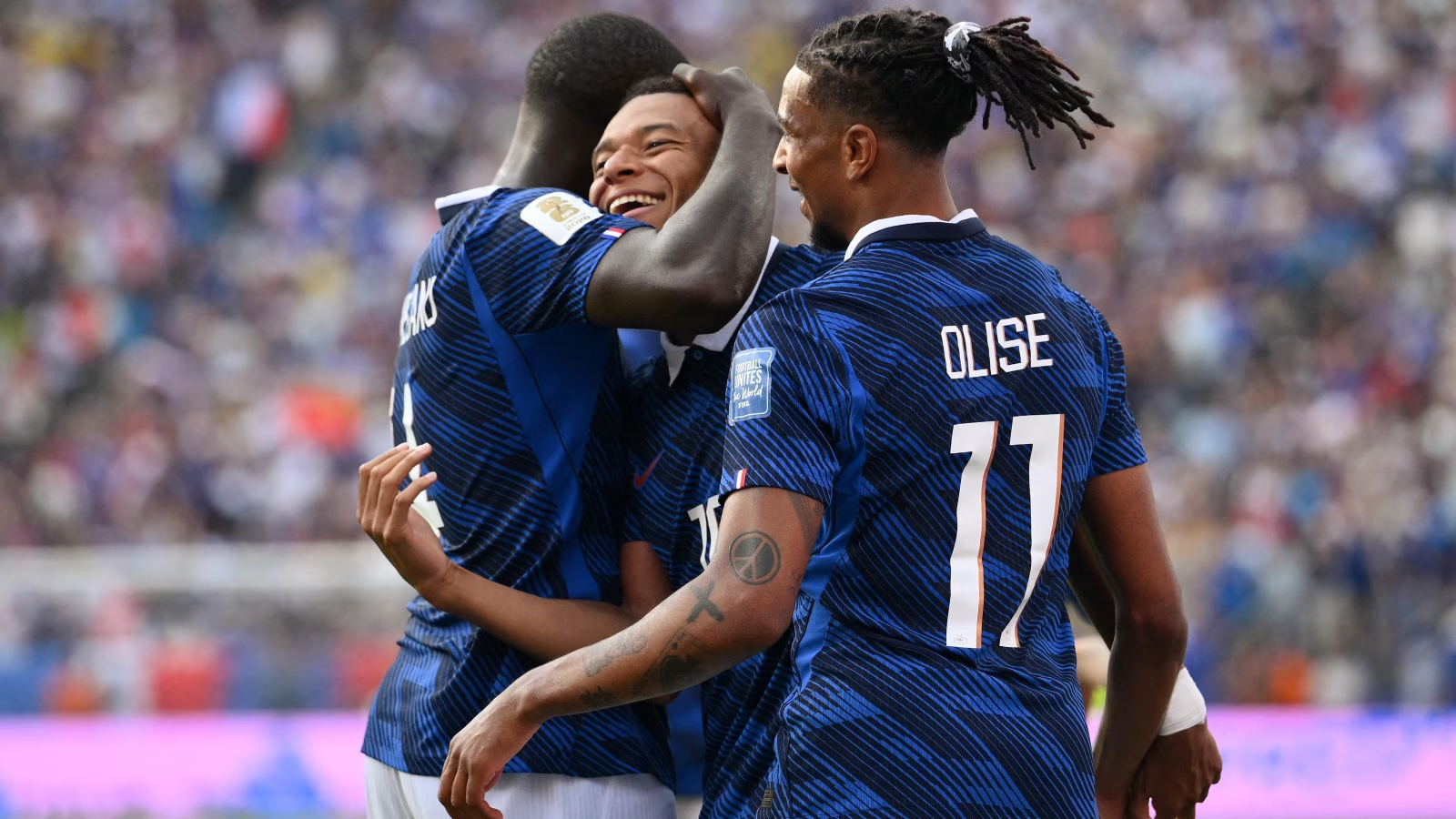
The 2026 FIFA World Cup has entered its decisive final stretch, with the quarter-finals now set and the first last-eight match scheduled for Thursday, 9 July 2026. The confirmed headline fixture is France against Morocco at Boston Stadium, a tie that immediately gives the knockout bracket a clear focal point as the race to reach the final intensifies. With the tournament reduced to its final eight, every result now carries direct consequences for the road to East Rutherford, New Jersey, where the final will be played on 19 July at New York New Jersey Stadium. At this stage, the standout force is the bracket itself, because the shape of the knockout draw now defines not only who survives, but how each contender must navigate the closing days of the competition.
- The 2026 FIFA World Cup has reached the quarter-final stage, with the first last-eight match scheduled for Thursday, 9 July 2026.
- One confirmed quarter-final pairing is France versus Morocco at Boston Stadium on 9 July.
- The knockout-stage bracket is active and now determines the route from the quarter-finals through to the final.
- The full set of quarter-final matchups is not completely detailed in the provided results, even though the lineup is set.
- The World Cup final is scheduled for 19 July in East Rutherford, New Jersey, at New York New Jersey Stadium.
A tournament narrowed to its sharpest edge
Reaching the quarter-final stage always changes the feel of a World Cup. Group-stage calculations are gone, and even the broad drama of the round of 16 gives way to something tighter and more unforgiving. From this point forward, there is no room for recovery, no second chance through another group fixture, and no way to smooth over a poor performance across a longer run of matches. The bracket becomes the central story because every team can now trace a direct line from a single result to the possibility of playing for the trophy.
That is why the confirmation of France against Morocco matters beyond the obvious appeal of the fixture itself. It is not simply another knockout tie; it is one of the matches that will shape the entire final week and a half of the tournament. A quarter-final win does more than keep a campaign alive, because it also determines who builds momentum, who controls their side of the draw, and who moves within touching distance of the final. With the route from the quarter-finals through to 19 July now active, every tactical decision and every spell of composure or pressure will carry heightened significance.
The bracket information provided also underlines a familiar truth about this stage of the competition: once the lineup is set, attention shifts from qualification to management of the moment. Teams are no longer judged only on whether they can advance, but on whether they can do so while preserving energy, confidence and clarity for the rounds still to come. Even without the complete list of quarter-final pairings detailed here, the structure of the knockout stage tells its own story. The World Cup has reached the point where ambition must be matched by execution over a very short and very intense sequence of matches.
That shift is what gives the last eight their particular edge. Earlier rounds can still allow for narrative twists, gradual improvement or tactical correction over time. The quarter-finals do not. Every remaining side is now close enough to the final for the destination to feel real, yet still far enough away that one mistake can end the campaign immediately. That tension sharpens every decision, from team selection to game management, and turns the bracket into more than a schedule. It becomes the framework through which the final phase of the tournament will be judged.
Why France vs Morocco carries immediate weight
France versus Morocco at Boston Stadium stands out because quarter-finals are often shaped as much by emotional control as by technical quality. The pressure of a single-elimination match can make even established teams cautious, while opponents who remain disciplined can turn the contest into a battle of patience and nerve. In that context, the opening phases of the game on 9 July will matter enormously, because they are likely to establish whether the match becomes open and transitional or measured and strategic. The team that settles first will gain more than territorial comfort; it will gain the ability to dictate the emotional rhythm of one of the tournament’s biggest nights.
For France, simply being in a confirmed quarter-final underlines the scale of expectation that follows a major football power deep into a World Cup. At this stage, the standard is no longer participation but progression, and every performance is examined through the lens of whether it looks strong enough to carry a side to the final. Morocco, meanwhile, enters the same occasion with the chance to shape the tournament narrative in its own way by turning a quarter-final appearance into something even bigger. The pairing therefore carries a natural tension, with one side measured against the burden of expectation and the other against the opportunity for a defining breakthrough.
The venue adds another layer to the occasion. Boston Stadium becomes more than a host site when it stages one of the first matches of the last-eight round, because it serves as the setting where the bracket truly begins to narrow. Quarter-finals are often remembered not only for who wins, but for how clearly they reveal a team’s readiness for the final push. A composed, authoritative performance can transform a contender’s outlook, while a laboured display can invite doubts even in victory. That is why this match will be watched not just for its outcome, but for the signs it offers about who is best equipped for the semi-final stage.
The wider bracket remains crucial even though the full set of matchups is not completely detailed here. Knowing that the lineup is set means the tournament has moved from possibility into defined consequence, and that is the point at which every remaining team can map its route with precision. Coaches and players do not need the noise of speculation now; they need clarity about the sequence of obstacles standing between them and the final in East Rutherford. The quarter-finals are where planning becomes highly specific, because the margins are so small and the turnaround between rounds can be so demanding.
There is also broader significance in the calendar itself. With the first quarter-final on 9 July and the final on 19 July, the remaining contenders are entering a compressed, high-stakes period in which recovery, tactical preparation and emotional resilience all become decisive. The teams that handle this stretch best will be the ones able to combine immediate intensity with a longer view of the bracket. Winning a quarter-final is essential, but doing so in a way that leaves a side ready for the semi-final can be just as important. That balance between urgency and preservation is one of the defining challenges of the World Cup’s closing rounds.
What comes next is straightforward in structure and enormous in consequence. The quarter-finals will determine the semi-finalists, the semi-finals will set the championship match, and the road ends on 19 July at New York New Jersey Stadium in East Rutherford, New Jersey. France and Morocco have the first confirmed chance to seize that momentum in Boston, where a place in the final four will be on the line. Beyond that fixture, the active bracket ensures that every remaining result will tighten the field further and sharpen the focus on the final. The World Cup is now in its purest knockout form, and every step from here leads directly toward the sport’s biggest stage.

Leave a Reply