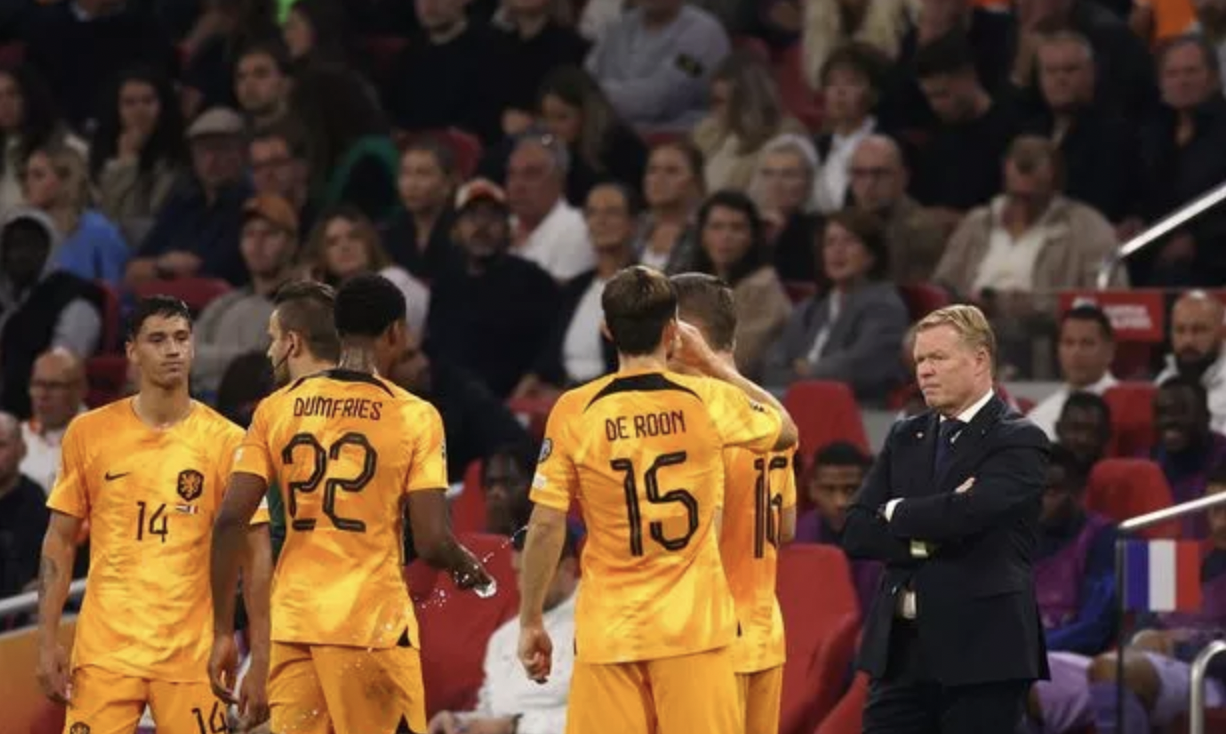
Ronald Koeman’s return as the manager of the Netherlands was seen as a calculated move, but his gamble on squad selection has only partially paid off.
The Netherlands, often viewed as perennial underachievers in world football, have not won a major tournament since their triumph 36 years ago in Germany. That victory, capped by Marco van Basten’s legendary volley against the USSR, remains a high point.
Post-retirement, Van Basten, among others, has struggled to replicate that success as a manager. The Dutch have not advanced past the quarter-finals of the Euros since 2008, highlighting their decline on the international stage.
Koeman, now in his second stint as manager, faces his first major tournament with a squad that reflects the limited quality at his disposal. Unlike Gareth Southgate, who could afford to leave an injured Harry Maguire behind, Koeman has had to take risks with three key players: Feyenoord’s Justin Bijlow, Atletico Madrid’s Memphis Depay, and Barcelona’s Frenkie de Jong.
Bijlow’s ongoing issues have seen Brighton’s Bart Verbruggen surpass him as the No.1 goalkeeper. Depay has struggled through recent matches, and most critically, De Jong had to withdraw from the squad on Monday evening, dealing a significant blow given his status as the team’s most talented and recognizable midfielder.
In De Jong’s absence, younger players must rise to the occasion. Liverpool duo Cody Gakpo and Ryan Gravenberch have yet to fulfill their potential, while AC Milan’s Tijjani Reijnders, having had a breakout season, and Teun Koopmeiners, fresh off a Europa League win with Atalanta, will need to step up.

The Netherlands’ qualifying campaign was a mixed bag, marked by two losses to France but six wins against lesser teams. This inconsistency reflects their position in the middle tier of international teams, capable of defeating weaker sides but struggling against elite opponents.
Koeman’s five losses as manager have come against top-tier teams like France, Croatia, Germany, and Italy. After securing a place at Euro 2024, he acknowledged the need for improvement to compete with top countries. “We really know that we need to improve in a number of areas to compete with the other top countries. It is clear that football can and must be improved,” Koeman said.
A favorable knockout draw could aid the Netherlands. Finishing second in Group D would likely mean avoiding a group winner in the next round. Facing a second-place team from Group E instead, potentially Ukraine, Romania, or Slovakia. This path could see them into the last eight, where anything is possible.
Koeman has emphasized the need for tactical flexibility, a hallmark of Dutch ‘Total Football’. He believes in a versatile squad capable of adapting their game plan. “I never pin myself to one system, not even at Barcelona or Ajax,” Koeman noted. “Sometimes that brought me success and sometimes less. You must have players who can play different systems.”
The Netherlands aim to surprise in Germany this summer, with few expecting them to reach the latter stages. Koeman’s adaptable approach could be key, and he will hope for success over the coming weeks.
